

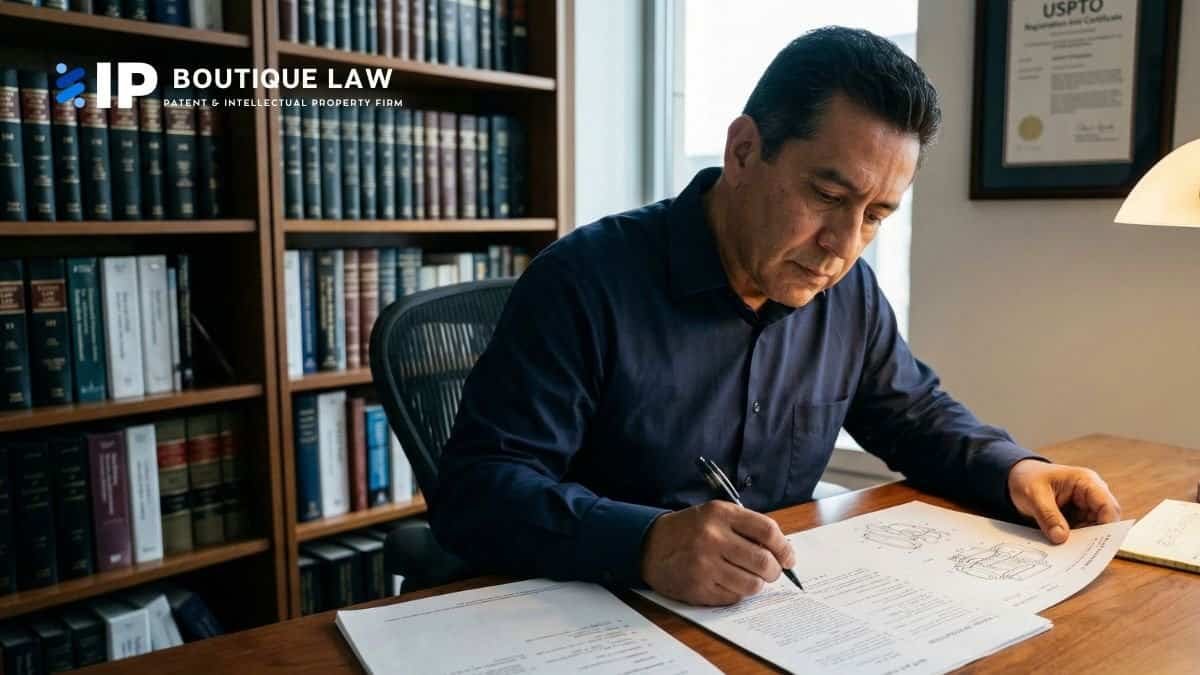
A professionally prepared provisional patent application costs between $2,000 and $5,000 in total — attorney fees included. The USPTO filing fee alone runs $65 for micro entities, $130 for small entities, and $325 for large companies, as listed in the current USPTO fee schedule. That government fee is not where the real cost lives. The drafting is.
Having reviewed thousands of provisional applications during our time at the USPTO, we can tell you what separates a $2,000 filing from a $5,000 one: the level of technical disclosure. An examiner reading a non-provisional application years later will look back at the provisional and ask whether every claimed element was explicitly described. If it wasn’t, that element cannot claim the benefit of the provisional’s filing date — regardless of what you paid to file it. Understanding total cost means understanding what you’re actually paying for.
At IP Boutique Law, our provisional patent application fees range from $2,000 to $5,000, depending on the technical complexity of your invention. That range reflects real differences in preparation work — not arbitrary pricing.
Last updated: March 2026
USPTO filing fees for a provisional patent application
The USPTO filing fee for a provisional application is the fixed government cost you pay regardless of who prepares your application. These fees are set by statute and apply based on your entity classification.
| Entity Type | Who qualifies | Provisional filing fee |
|---|---|---|
| Micro entity | Independent inventors below income threshold, no more than 4 prior patent filings | $65 |
| Small entity | Individuals, small businesses (≤500 employees), universities | $130 |
| Large entity | Companies with more than 500 employees | $325 |
Source: USPTO Fee Schedule, effective January 19, 2025, last revised March 1, 2026
One additional fee applies if your application exceeds 100 pages: $90 per additional 50 sheets for micro entities, $180 for small entities, and $450 for large entities. For the vast majority of inventions, applications stay well under that threshold.
Unlike non-provisional applications, provisional applications do not require a search fee or examination fee. No additional USPTO fees apply at filing beyond the basic filing fee and the size fee if applicable.
Attorney fees — what drives the range
The $2,000–$5,000 range for attorney preparation reflects the actual drafting work required, which varies significantly based on your invention’s technical complexity. These are the three broad categories we work with:
Simple to moderate mechanical inventions — $2,000 to $3,000. Inventions with a limited number of components, straightforward assembly, and no software or chemical elements. A new type of fastener, a mechanical tool, a physical consumer product. The specification needs clear structural description and operational detail, but the scope of disclosure is manageable.
Electrical, electronic, and moderate software inventions — $3,000 to $4,000. Inventions with circuit architectures, embedded systems, algorithms, or user-interface elements require more extensive technical description. The relationship between components — not just their existence — must be captured in enough detail to support future claims.
Biotech, chemical, pharmaceutical, and complex software inventions — $4,000 to $5,000. These require the most extensive specification work. Chemical processes need reaction conditions, compound structures, and experimental data. Biotech inventions often require sequence information and enablement-level detail. Software with AI or ML components needs technical depth beyond feature description.
What determines where your invention falls within a range: the number of distinct embodiments you want protected, the number of figures needed, and whether prior art research is included in the engagement. At IP Boutique Law, we provide a specific estimate after reviewing your invention disclosure — not a guess based on a category label.
What the drafting fee actually pays for
Most inventors focus on the USPTO fee because it’s the number they can find immediately. The attorney fee is less visible, so it’s worth being clear about what it covers.
When we prepare a provisional patent application at IP Boutique Law, the work includes a complete technical specification, drawing coordination, and USPTO electronic filing through Patent Center. The specification is not a summary of your invention. It’s a patent-quality technical document that describes your invention in enough detail that someone skilled in your field could build and use it without experimentation. That standard — called enablement — is what determines whether your provisional can actually support the non-provisional claims you’ll file within 12 months.
Here is what we see from the examiner’s side of this: when a non-provisional patent application comes in claiming priority from a provisional, we read the provisional carefully. If an applicant wants to claim “a system comprising elements A, B, and C,” every one of those elements needs to appear in the provisional specification with enough technical context to show what it does and how it works in the system. A provisional that describes A and B but treats C as implied doesn’t provide written description support for C. The applicant loses the priority date for that element — which means a competitor who filed after them but before the non-provisional could potentially claim that ground.
That’s not a theoretical risk. It’s a routine source of prosecution problems that we’ve seen from both sides of the desk. A thin provisional saves money today and costs significantly more during non-provisional prosecution — often in the form of narrowed claims or lost priority arguments.
Total cost by entity type and invention complexity
The table below shows realistic total costs for a provisional patent application, combining USPTO government fees with professional preparation fees. These figures reflect the full filing — specification drafting, drawing coordination, and USPTO submission.
| Invention complexity | USPTO fee (small entity) | Attorney fees | Total estimate |
|---|---|---|---|
| Simple mechanical | $130 | $2,000 – $2,500 | $2,130 – $2,630 |
| Electrical / moderate software | $130 | $3,000 – $3,500 | $3,130 – $3,630 |
| Biotech / complex software | $130 | $4,000 – $5,000 | $4,130 – $5,130 |
Micro entity applicants subtract $65 from the USPTO fee column. Large entity applicants add $195.
For context: the non-provisional patent application filed within 12 months typically costs $7,000–$10,000 in attorney fees plus USPTO filing, search, and examination fees — a combined government cost of $800 for small entities. A well-prepared provisional reduces the work required during non-provisional prosecution because the specification foundation is already solid. A poorly prepared provisional increases it, sometimes substantially.
A preliminary patent search can be a smart addition before or alongside the provisional, particularly for inventions in crowded fields. Knowing what prior art exists helps shape the specification toward patentable distinctions from the start.
What a strong provisional prevents — and what a thin one costs you
Inventors sometimes view the provisional as a placeholder — a way to buy 12 months cheaply before deciding whether to invest in a full application. That framing is understandable, but it carries real legal risk that doesn’t become visible until prosecution.
Narrow claim scope in the non-provisional. If your provisional describes one embodiment of your invention and your non-provisional tries to claim a broader category, the examiner will ask whether the broader category has written description support in the provisional. If it doesn’t, the broader claims either get rejected or must be narrowed. Competitors can now design around what you couldn’t protect.
Loss of foreign filing rights. The 12-month provisional period is also your window for PCT and foreign national-phase filings. Those applications must have adequate written description support in the priority document. A provisional that’s light on technical detail undermines international filings even if it was sufficient for U.S. purposes.
Prosecution history that works against you. Examiners distinguish between claims supported by careful disclosure and claims that are being stretched beyond what was originally described. We know this because we’ve made those distinctions ourselves. Arguments that don’t track back to specific provisional disclosure tend to narrow the claim scope rather than preserve it.
The decision to invest in thorough provisional drafting isn’t a philosophical one. It’s a calculation about what your invention is worth and what you’ll need to defend it.
Frequently asked questions
Total cost depends on two components: the USPTO filing fee ($65–$325 depending on entity size) and attorney preparation fees ($2,000–$5,000 depending on invention complexity). Most independent inventors and small companies pay $2,130 to $3,630 in total for a professionally prepared provisional patent application. DIY filing is possible for the USPTO fee only, but disclosure quality typically suffers in ways that affect non-provisional prosecution.
No, the USPTO does not require attorney representation to file a provisional application. You can prepare and file the document yourself. The practical question is whether your specification will have adequate written description to support the claims you’ll want in your non-provisional. IP Boutique Law works with inventors who have drafted their own provisionals and can assess whether the disclosure is sufficient before you commit to conversion.
A provisional patent application has a fixed 12-month pendency period from the filing date. The USPTO does not grant extensions. At the end of 12 months, the provisional expires automatically unless a non-provisional application claiming its benefit has been filed. If you miss the deadline, you lose the provisional’s priority date entirely.
The provisional application expires and your priority date is lost. Any public disclosure of your invention during the 12-month period — investor pitches, product launches, publications — could then be used as prior art against a later non-provisional filing. In countries with absolute novelty requirements, that public disclosure may bar foreign patents entirely.
For most inventors, yes — provided the provisional is drafted with adequate technical detail. The 12-month window lets you test market interest, refine the invention, and raise funding before committing to the full non-provisional cost. The risk is treating the provisional as a cheap placeholder and underinvesting in the specification. The priority date is only as strong as the disclosure behind it.
Schedule a consultation about your provisional patent application
Total provisional patent application cost — including attorney fees — runs $2,000 to $5,000 at IP Boutique Law, depending on your invention’s technical complexity. The USPTO filing fee adds $65 to $325 depending on your entity size. We work on flat-fee arrangements, so there are no hourly billing surprises.
If you have an invention you need to protect, the first conversation is about understanding what you’ve built and what level of disclosure it needs. We’ve been on the examining side of this process and know what a provisional needs to look like to actually support the claims you’ll want to own.
Schedule a consultation to discuss your invention and get a cost estimate specific to your situation.
- Phone: +1 202 773 9579
- Email: contact@ipboutiquelaw.com
- Contact form: ipboutiquelaw.com/contact
IP Boutique Law is a patent and intellectual property firm in Washington, D.C. with 25+ years of USPTO examiner experience. Our team handles patent drafting, prosecution, trademark registration, design patents, provisional applications, ex parte reexamination, and patent reissue across chemical, biochemical, electrical, and mechanical fields. We serve inventors and companies in the U.S. and internationally, bringing insider examiner knowledge to every stage of the patent process.
Reviewed by Carlos López, patent attorney and former USPTO patent examiner with 25+ years of IP experience.