

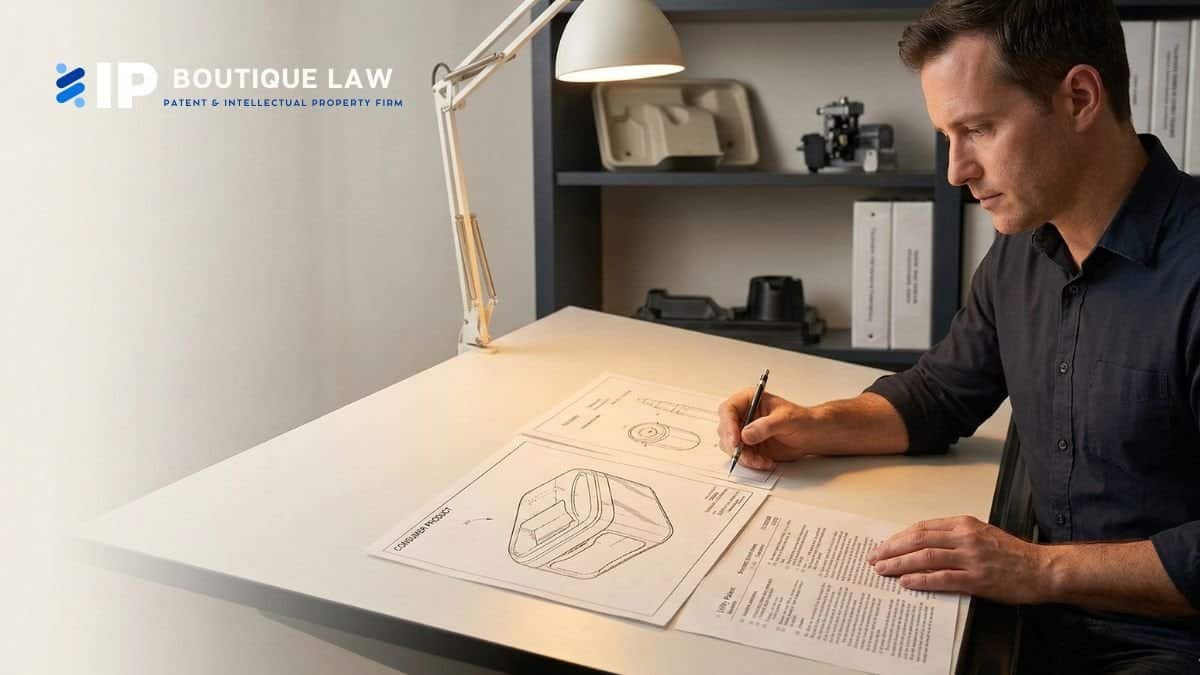
A design patent protects how an article looks; a utility patent protects how it works. That single distinction drives every difference that follows — what the examiner reviews, how much it costs, how long prosecution takes, and how hard it is for a competitor to get around your protection. Choosing the wrong type doesn’t just waste money. It can leave your actual competitive advantage unprotected.
We’ve been on both sides of this decision. Having examined patent applications at the USPTO, we know exactly what the examiner’s job looks like for each type — and that examiner-level knowledge is what we bring to every design patent application and utility filing we handle for clients.
Last updated: March 2026
What each patent actually protects
A design patent, governed by 35 U.S.C. § 171, covers the ornamental appearance of an article of manufacture — its shape, configuration, surface ornamentation, or any combination of these. The design must be non-functional: if the appearance is dictated entirely by how the product must work, it cannot be protected by a design patent. What the drawings show in solid lines is what is claimed.
A utility patent, governed by 35 U.S.C. § 101, protects the functional aspects of an invention — the way it works, how it’s made, a process it performs, or a composition of matter. Protection attaches to the written claims, not the drawings. A competitor can build a product that looks completely different from yours and still infringe a utility patent if it performs the claimed function.
Both types are legitimate, enforceable patents issued by the USPTO. Both grant the owner the right to exclude others from making, using, selling, or importing the covered invention in the United States. And both can apply to the same product when appearance and function are independently novel — the iPhone’s distinctive shape and the technology inside it are protected by separate patent types for exactly this reason.
How the examination process differs
This is where insider knowledge matters most, and where most articles stop at the surface.
When a design patent examiner reviews your application, the primary job is a visual comparison. Under MPEP § 1504, the examiner searches prior art for designs that are substantially similar to yours — looking at the drawings, not reading claims. There is a single claim in every design application, referring to the ornamental design as shown in the figures.
Because the examiner’s analysis is largely visual rather than claim-by-claim, design applications move through examination faster and with fewer rejections. The USPTO’s design patent allowance rate has historically run around 84%, meaning roughly 7 out of 8 applications are allowed. That’s not because design standards are lax — it’s because the scope is narrow and well-defined.
When a utility patent examiner reviews your application, the job is substantially more complex. The examiner must confirm the specification satisfies 35 U.S.C. § 112 — that the disclosure enables someone skilled in the field to make and use the invention, and that every claim finds adequate written description support. Then the examiner conducts prior art searches under 35 U.S.C. § 102 (novelty) and § 103 (non-obviousness), often combining multiple references to reject individual claims.
First-office-action rejections are the norm, not the exception — roughly 90% of utility applications receive at least one rejection before allowance.
One procedural difference with real strategic weight: utility applications can be reopened via a Request for Continued Examination (RCE) after a final rejection, giving the applicant another round of prosecution. Design applications cannot. If a design application receives a final rejection, the path forward is an appeal to the Patent Trial and Appeal Board (PTAB) — a higher bar. In practice, because design allowance rates are high, this matters less often. But it’s worth knowing before you file.
Cost and timeline comparison
The difference in examination complexity explains most of the cost gap.
| Design patent | Utility patent (non-provisional) | |
|---|---|---|
| USPTO filing fee (small entity) | $120 | $140 |
| USPTO search fee (small entity) | $120 | $308 |
| USPTO examination fee (small entity) | $280 | $352 |
| USPTO issue fee (small entity) | $520 | $516 |
| Total USPTO fees (small entity) | ~$1,040 | ~$1,316 |
| Maintenance fees | None | $900 / $1,600 / $4,000 (at 3.5, 7.5, 11.5 years post-grant) |
| Attorney fees | $1,000–$2,000 | $2,000–$15,000+ depending on complexity |
| Average time to allowance | 18–24 months | 30–36+ months |
| Patent term | 15 years from grant | 20 years from filing |
Source: USPTO fee schedule, effective January 19, 2025, last revised January 1, 2026. Full fee schedule at https://www.uspto.gov/learning-and-resources/fees-and-payment/uspto-fee-schedule
Micro entity applicants (qualifying individuals who meet income and prior filing thresholds) pay half the small entity rate — roughly $520 total in USPTO fees for a design application. Standard entity fees are higher; the table above uses small entity rates, which apply to most independent inventors and small businesses.
The maintenance fee difference is significant over a patent’s life. A utility patent that reaches full term will cost its owner approximately $6,500 in maintenance fees alone, on top of prosecution costs. Design patents have no maintenance fees — the 15-year term requires no additional payments after the issue fee.
When to file a design patent, a utility patent, or both
The right answer depends on where your competitive advantage actually lives.
File a design patent when:
- The appearance of your product is what drives purchase decisions and sets you apart — consumer goods, fashion accessories, packaging, medical device aesthetics, furniture
- You need faster, more affordable protection while a utility application is still being drafted or prosecuted
- You want to protect a graphical user interface (GUI), icon, or screen display element — companies like Google and Meta actively use design patents for this purpose
- Competitors could copy the look of your product and take market share without copying any functional innovation
File a utility patent when:
- The function or process is what makes your invention novel — a competitor could build something that looks completely different but does the same thing
- You need protection that covers the broadest possible set of products performing the claimed function, regardless of appearance
- The invention has a long commercial life that justifies prosecution costs and maintenance fees
- You are building a portfolio for licensing or acquisition purposes
File both when:
- Both the appearance and the function are independently novel
- The product competes in a market where copying is fast (consumer electronics, consumer goods)
- Layering protection makes it significantly harder for a competitor to find a clean design-around
This last scenario comes up more often than inventors expect. Filing a non-provisional patent application alongside a design application is a legitimate strategy when both aspects of the product are genuinely novel. The key qualifier: both have to stand on their own. Filing a design patent on something that primarily has utility value — just because design patents are cheaper — is a common mistake we’ve seen pushed on inventors by less experienced counsel. It provides narrow, circumventable protection where broader utility protection was available.
If you’re early in the process and haven’t determined which type applies, a patent search is the right first step — before spending on drafting either application.
How infringement works differently for each
The infringement standard is where the practical difference between these two patent types becomes clearest.
For a design patent, infringement is determined by the “ordinary observer” test, established by the Federal Circuit in Egyptian Goddess, Inc. v. Swisa, Inc. (2008). The question is whether an ordinary observer, giving the attention a typical purchaser would give, would find the accused product and the patented design substantially similar — similar enough to cause confusion about which they were buying. This is a visual, side-by-side comparison of the drawings against the accused product. Because scope is limited to what appears in the figures, a competitor who creates a product with a noticeably different appearance will generally avoid infringement, even if the products serve the same function.
For a utility patent, infringement turns on the written claims. Every element of at least one claim must be present in the accused product or process. Appearance is irrelevant. A competitor’s product can look entirely different from the patented invention and still infringe if it performs the claimed function. This is why utility patents are substantially harder to design around — and why they’re worth the higher cost when the function is where the value lives.
Frequently asked questions
A design patent is worth it when the ornamental appearance of your product is a genuine competitive asset — when copying the look is what gives a competitor an unfair advantage. For consumer products where aesthetics drive purchase decisions, design patents provide real protection at a fraction of utility patent cost. They’re less valuable when the innovation is primarily functional, because a competitor can redesign the appearance and remain outside the patent’s scope.
Yes. The USPTO allows both types on the same product when both the appearance and function are independently novel. This is a common strategy in consumer electronics, consumer goods, and medical devices. The applications are filed and prosecuted separately. A provisional patent application can preserve your filing date for the utility path while you finalize both applications.
A design patent filed on or after May 13, 2015 lasts 15 years from the grant date, with no maintenance fees required. Design patents filed before that date last 14 years. There are no renewal payments — once issued, the protection runs its full term without additional fees.
A design patent is significantly less expensive. Total USPTO fees for a small entity run approximately $1,040 for a design patent vs. roughly $1,316 for a non-provisional utility application before maintenance fees — and utility patents require three maintenance payments totaling approximately $6,500 over the patent’s life. Attorney fees are also lower for design applications because drafting involves drawings rather than the multi-claim specification required for utility patents. At IP Boutique Law, design patent drafting ranges from $1,000–$2,000; utility patent preparation starts at $2,000 and scales with technical complexity.
A classic example is an ergonomic chair. The utility patent covers the mechanical adjustments — the specific swivel mechanism, lumbar support system, or armrest adjustment method. The design patent covers the chair’s distinctive visual appearance: its shape, profile, and surface features. The utility patent protects anyone from copying how it works; the design patent protects anyone from copying how it looks. Both can coexist, and together they make the invention much harder to replicate without infringement.
Working with an examiner who has seen both sides
Choosing between a design patent and a utility patent is a strategic decision, not just a procedural one. The wrong choice — or an incomplete strategy — can leave your real competitive advantage exposed.
IP Boutique Law is a patent and intellectual property firm in Washington, D.C. with 25+ years of USPTO examiner experience. Our team handles patent drafting, prosecution, trademark registration, design patents, provisional applications, ex parte reexamination, and patent reissue across chemical, biochemical, electrical, and mechanical fields. We serve inventors and companies in the U.S. and internationally, bringing insider examiner knowledge to every stage of the patent process.
Having worked inside the USPTO, we know what examiners look for in each type of application — what gets design patents allowed quickly, and what gets utility applications rejected. That perspective shapes how we draft, how we argue, and how we advise clients on which path is actually worth pursuing.
Let’s discuss what you’re trying to protect and which approach makes sense for your situation. Call us at +1 202 773 9579, email contact@ipboutiquelaw.com, or schedule a consultation.
Reviewed by Carlos López, patent attorney and former USPTO examiner with 25+ years of IP experience.