

Last updated: July 2026
A federal trademark registration typically takes 12 to 18 months from filing to certificate, though the exact number depends heavily on what happens once an examining attorney opens your file. If you’re weighing whether to handle the filing yourself or bring in trademark registration counsel, the honest answer is that the timeline isn’t really about paperwork speed. It’s about how many times your application has to go back and forth with an examiner before it clears.
That 12–18 month range comes straight from the USPTO’s own guidance, and it holds up against current data. According to the USPTO Trademarks Dashboard, the agency’s target for first action pendency this fiscal year is five months from filing, with a long-term goal of 4.5 months. Total pendency for applications that don’t involve a Trademark Trial and Appeal Board (TTAB) proceeding averages around 14 months.
Those numbers matter more than the general range you’ll find on most law firm blogs, because they show where the clock actually runs: not evenly across the process, but in long stretches of queue time punctuated by short bursts of examiner activity.
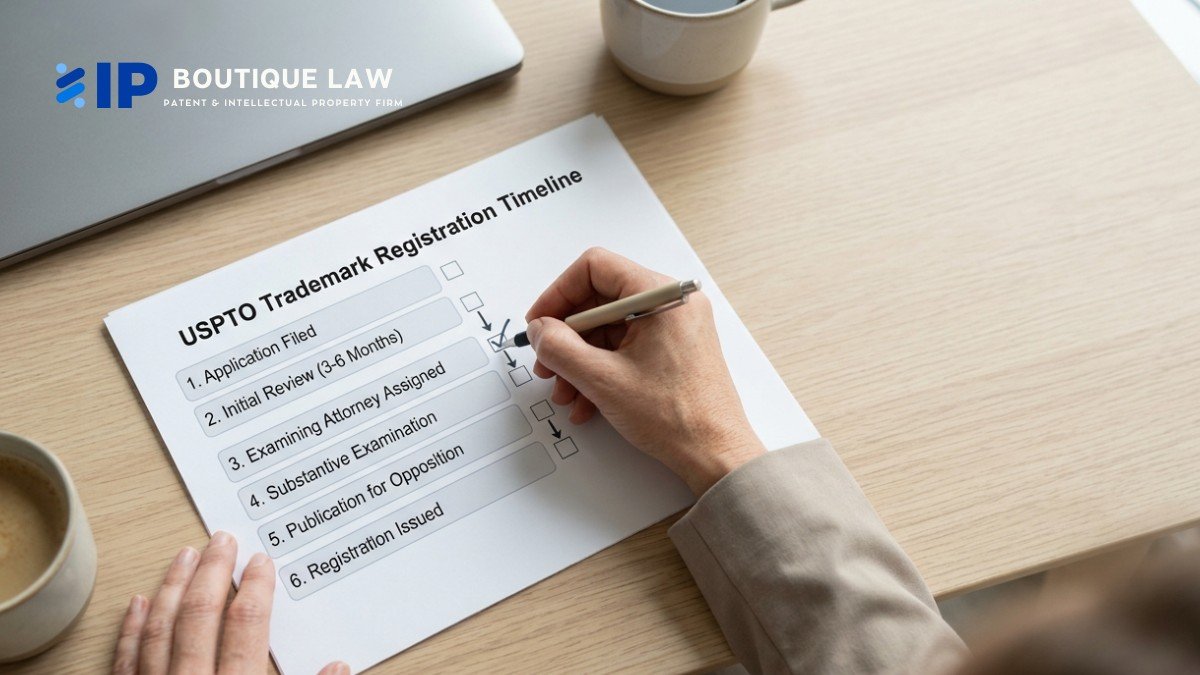
The full timeline, stage by stage
Filing is the fast part. Everything after it is a queue. Per the USPTO’s published processing wait times, new applications typically sit for several months before an examining attorney is assigned, and that assignment window accounts for most of the total timeline.
| Stage | Typical duration | What’s happening |
|---|---|---|
| Filing to first assignment | 5–9 months | Application sits in the examination queue before an examiner opens the file |
| Examining attorney’s first review | Within the assignment window above | Examiner checks the mark, the goods/services description, and the specimen |
| Response to office action (if issued) | Up to 3 months, plus a 3-month extension option | Applicant addresses refusals or requirements |
| Approval to publication | About 1 month | Mark is approved and scheduled for the Official Gazette |
| Publication and opposition period | 30 days | Third parties can oppose; extensions are possible |
| Notice of Allowance to Statement of Use (1(b) only) | Up to 3 years, in 6-month extensions | Applicant proves actual use before registration issues |
| Registration | Roughly 2–4 weeks after opposition period closes or SOU is accepted | Certificate issues |
An application with a clean specimen, a precise identification of goods, and no conflicting marks can clear this whole sequence closer to the 8–12 month mark. One that draws an office action, especially a substantive refusal, is realistically looking at 12–18 months even with a fast response.
What determines your timeline: examination outcomes, not paperwork
Here’s the part most explanations skip. Two applications filed the same week can finish six months apart, and the difference almost never comes down to how fast the forms were completed. It comes down to what the examining attorney finds when they actually look at the file. That’s exactly where a trademark attorney who has sat on the examiner’s side reads a filing differently than someone drafting from a template.
Since January 18, 2025, the USPTO has used a single Base application fee of $350 per class, replacing the old TEAS Plus and TEAS Standard tiers. What used to be a binary choice between two filing options is now a base fee plus targeted surcharges: $100 per class for an incomplete or non-standard goods/services description pulled from the USPTO’s ID Manual, and $200 per class for a custom description that requires manual review.
Applications that trigger those surcharges don’t automatically take longer, but they correlate with exactly the kind of imprecise drafting that produces office actions later. A complete, correctly classified application filed under the Base fee with no surcharges is more likely to receive what the USPTO calls “first action approval”: approval with no office action at all, which can shave months off the total.
The office actions that add the most time tend to fall into a small number of categories:
- Likelihood of confusion refusals under §2(d): the examiner finds a registered or pending mark that’s too close in sound, meaning, or commercial impression, even if the spelling differs.
- Descriptiveness refusals under §2(e)(1): the mark directly describes a feature or quality of the goods, and no acquired distinctiveness evidence was submitted.
- Specimen refusals: the submitted proof of use doesn’t show the mark in actual commerce, such as mockups, website screenshots without ordering capability, or promotional material instead of a real transaction.
- Identification of goods and services problems: descriptions too broad, too vague, or worded outside the USPTO’s approved classification language.
Each of these adds a three-month response window at minimum, and a second office action is common if the first response doesn’t fully resolve the examiner’s concerns. Oppositions push the timeline further still, sometimes past 24 months, because no further action happens while a TTAB proceeding is pending.
Base application vs. surcharge triggers: why filing quality moves the clock
A precise identification of goods matters more to your timeline than most applicants expect, and getting it right starts before the application is ever filed. Descriptions drawn from the USPTO’s pre-approved ID Manual avoid the $200 custom-description surcharge and reduce the odds of a rejection on classification grounds. A thorough clearance search before filing, one that checks phonetic equivalents and overlapping goods categories, not just identical marks, is what actually prevents the §2(d) refusals that add months to a case.
We’ve reviewed thousands of applications from the examiner’s side, and the pattern is consistent: marks that clear the identification and specimen review cleanly on the first pass are the ones where someone did the clearance and drafting work carefully before submission, not the ones that happened to get lucky with examiner assignment.
The same logic applies to descriptions of goods and services. Attorneys who draft outside the USPTO’s pre-approved ID Manual language, whether to capture something more specific to the client’s business or simply through unfamiliarity with the manual, trigger the $200 custom-description surcharge and invite closer scrutiny during examination.
Using approved language wherever it fits the goods, and reserving custom drafting for genuinely novel goods that need it, keeps both the fee and the examination risk down.
Intent-to-use vs. use-based filings: a real timeline difference
Applications filed under Section 1(a), based on use already in commerce, and Section 1(b), based on a bona fide intent to use the mark, follow the same examination process up through publication. After that, they diverge. A 1(a) applicant who clears publication without opposition gets a registration certificate directly. A 1(b) applicant instead receives a Notice of Allowance and then has six months to file a Statement of Use showing the mark is actually in commerce, or to request an extension.
Extensions are available up to five times, six months each, giving an intent-to-use applicant as long as three years after the Notice of Allowance to prove use before the case is abandoned, per the USPTO’s Section 1(b) filing timeline. In practice, this means two applications that looked identical at filing can finish more than two years apart if one applicant needed the full extension window and the other filed under 1(a) from the start. For step-by-step guidance on the filing basis decision, the choice between 1(a) and 1(b) should be made deliberately, not as a formality.
What applicants can do while waiting
Most of the 12–18 months is passive waiting, but the waiting period isn’t empty of useful work. It’s often when clients working with our trademark registration team start preparing for the Statement of Use stage rather than treating it as a future problem.
- Monitor the file actively. Use the Trademark Status and Document Retrieval (TSDR) system to check status rather than assuming no news is good news; deadlines for responding to office actions run whether or not you’re watching for them.
- Prepare specimen evidence in advance, especially for 1(b) applicants who know they’ll need a Statement of Use eventually. Photographs of goods bearing the mark as sold, or web pages with functioning ordering systems, hold up far better than material assembled hastily against a deadline.
- Watch for third-party filings in your goods/services category. A newly filed application close to yours doesn’t affect your priority date, but it’s worth knowing about before it becomes an opposition.
- Keep using the mark consistently in the form filed. Material changes to a logo or wording during the pendency period can create a gap between what’s registered and what’s actually in use.
There’s no standard expedited examination track for routine applications. Petitions to make special exist for narrow circumstances like pending litigation, but for most filers, the most effective lever is filing a clean, correctly classified application the first time.
What applicants ask us most about registration timing
No. Most office actions raise issues that can be resolved through amendment or argument rather than a flat refusal. Non-substantive issues, like fixing a classification error or clarifying a description, are usually resolved in a single response. Substantive refusals under §2(d) or §2(e)(1) take more work to overcome but are frequently resolved with the right evidence and argument, not abandoned outright.
There’s no general expedited option for standard applications. The most effective way to shorten your practical timeline is avoiding the delays within your control: file a precise, well-classified application, submit a specimen that clearly shows use in commerce, and respond to any office action as early in the three-month window as possible rather than waiting until the deadline.
You can use ™ as soon as you begin using the mark in commerce, even before filing, since it doesn’t require registration. The ® symbol is reserved for marks that have actually completed federal registration. Using ® before registration issues can create legal complications, so it’s worth waiting for the certificate.
An opposition proceeding before the TTAB can extend a case well past the 18-month range, sometimes to 24 months or longer, because no further registration activity happens until the proceeding resolves. Oppositions function similarly to federal litigation, and most applicants facing one benefit from experienced counsel rather than managing it alone.
Not necessarily at the examination stage. Both filing bases go through the identical review process up to publication. The difference shows up afterward: a 1(b) applicant still needs to file a Statement of Use before registration issues, which can add anywhere from a few months to nearly three years depending on how quickly the mark goes into actual use.
The bottom line on trademark timing
Most straightforward applications register in 12 to 18 months, and the applications that beat that range are almost always the ones that arrived at examination already clean: correct classification, a specimen that holds up under scrutiny, and a clearance search thorough enough to catch conflicts before they become office actions. The applications that stretch past 18 months are rarely victims of a slow USPTO; they’re usually working through avoidable substantive refusals one response cycle at a time.
IP Boutique Law is a patent and intellectual property firm in Washington, D.C. with 25+ years of USPTO examiner experience. Our team handles patent drafting, prosecution, trademark registration, design patents, provisional applications, ex parte reexamination, and patent reissue across chemical, biochemical, electrical, and mechanical fields. We serve inventors and companies in the U.S. and internationally, bringing insider examiner knowledge to every stage of the patent process.
If you’re preparing to file, or you’re already mid-examination and want a second set of eyes on an office action, let’s discuss where your application stands and what the realistic path to registration looks like from here. Reach our team at +1 202 773 9579, email contact@ipboutiquelaw.com, or schedule a consultation through our website.
Reviewed by Carlos López, patent attorney and former USPTO examiner with 25+ years of IP experience.