

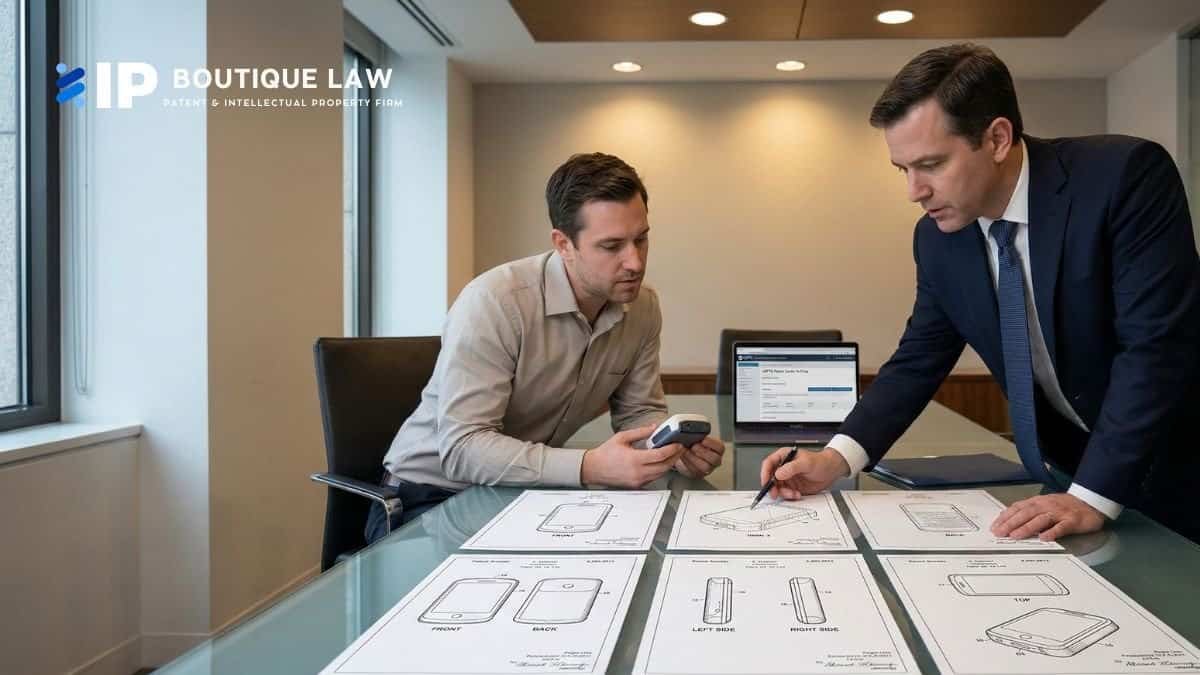
A design patent costs between $1,600 and $4,500 all-in for most inventors — covering USPTO government fees, professional drawings, and attorney fees from filing through the Notice of Allowance. Where you land in that range depends on three things: your entity size (micro, small, or large), the complexity of your design, and whether an office action comes back requiring a response.
Unlike utility patents, design patents carry no maintenance fees for the full 15-year term, so the cost you pay upfront is largely the cost you pay total. Having reviewed thousands of design applications as a former USPTO patent examiner, we see applicants consistently surprised by two things: how affordable design patents are relative to utility patents, and how much of the cost variation traces back to drawing quality, not attorney time.
Last updated: February 2026
USPTO fees for a design patent application
The USPTO charges separate fees for filing, searching, and examining a design patent application. These are government fees paid directly to the patent office — they apply regardless of whether you use an attorney. All figures below reflect the fee schedule last revised March 1, 2026, available at the USPTO fee schedule.
Filing, search, and examination fees by entity tier
| Fee type | Large entity | Small entity | Micro entity |
|---|---|---|---|
| Basic filing fee | $300 | $120 | $60 |
| Design search fee | $300 | $120 | $60 |
| Design examination fee | $700 | $280 | $140 |
| Total (filing through exam) | $1,300 | $520 | $260 |
Small entity status applies to independent inventors, nonprofit organizations, and businesses with fewer than 500 employees. Micro entity status requires meeting additional income and prior-filing criteria under 37 CFR 1.29 — if you qualify, the savings are real: micro entity fees are 80% below large entity rates.
Issue fee
If the USPTO allows your application, a separate issue fee is due within three months of the Notice of Allowance. As of March 2026:
- Large entity: $1,300
- Small entity: $520
- Micro entity: $260
This brings the total government cost — from initial filing through issuance — to $2,600 for large entities, $1,040 for small entities, and $520 for micro entities. There are no maintenance fees after grant for design patents. That is a meaningful financial difference from utility patents, which require payments at 3.5, 7.5, and 11.5 years post-grant.
Optional USPTO fees worth knowing
Rocket Docket (expedited examination): The USPTO’s expedited examination program for design patents, referenced in MPEP § 1504.30, requires filing a design patent search before submission. Total additional cost: roughly $700–$1,000 in government fees, plus the cost of the prior art search. If your product launch depends on having “patented” status quickly, this is worth discussing with your attorney.
Restriction requirement: If your original application shows two distinct designs, the examiner may issue a restriction requirement asking you to elect one for prosecution. This is an office action — it does not trigger a rejection fee, but it does require an attorney response, adding to prosecution cost.
IDS (Information Disclosure Statement): If you’re aware of prior art — a related foreign application, a prior publication, or a patent search result — you have a duty to disclose it under 37 CFR 1.56. Filing an IDS is straightforward but requires preparation time.
Attorney fees and drawing costs
Attorney fees for a design patent application are lower than for utility patents because design applications have a simpler structure — a single claim, no independent claims to negotiate scope on, and a specification that primarily references the drawings. What an attorney brings is strategic value: knowing how to frame the drawings to maximize protection without overclaiming, and knowing what examiners will flag before they flag it.
At IP Boutique Law, our attorney fees for design patent drafting and filing range from $1,000 to $2,000 depending on complexity. That range reflects the nature of the work: a straightforward consumer product with a clean geometric form sits at the lower end; a design with multiple embodiments, complex surface ornamentation, or significant prior art considerations requires more preparation.
Professional drawing costs and why USPTO drawing standards matter
Patent drawings are not a commodity in design cases — they are the entire claim. Under MPEP § 1503.02, design patent drawings must constitute a “complete disclosure of the appearance of the design,” with nothing left to conjecture. This is a standard that general illustrators and foreign drafting services frequently miss.
Examiners object to drawings that:
- Use solid black shading on three-dimensional surfaces instead of proper surface shading and stippling
- Show environmental structure in solid lines (it must appear in broken lines, per 37 CFR 1.152)
- Contain inconsistencies between views — a curve shown in the front view that does not match the side view
- Omit required orthographic views without a specification statement explaining why
Drawing objections under 35 U.S.C. § 112 or 37 CFR 1.84 delay allowance by months. In some cases, they require a full redraw and resubmission. Professional patent illustrators with specific USPTO experience typically charge $300–$800 for a design patent drawing set — less for simple geometric forms, more for multi-view consumer products or industrial designs with complex surface treatment.
Office action response costs
Design patents have an allowance rate significantly higher than utility patents — the USPTO has historically allowed design applications at roughly 85–90%. Most applications go straight from filing to Notice of Allowance without a substantive rejection. When an office action does come back, it is often a drawing objection or a restriction requirement, not a prior art rejection. Responding to a drawing-related office action costs $500–$1,500 in attorney time. A substantive prior art rejection — rarer, but not uncommon for designs close to existing products — costs $1,000–$2,500 to address.
At IP Boutique Law, we review the prior art landscape before filing specifically to assess this risk. Having examined design applications at the USPTO, we know which design categories see the most prior art rejections — consumer electronics, furniture, and apparel accessories chief among them — and we prepare applications accordingly.
Total design patent cost — all-in breakdown
The table below shows realistic total costs from filing through issuance, by entity size and scenario. These figures combine USPTO fees, attorney drafting fees (IP Boutique Law rates), professional drawings, and the issue fee. They assume electronic filing through Patent Center.
| Scenario | USPTO fees (filing + exam + issue) | Attorney + drawings | Total all-in |
|---|---|---|---|
| Micro entity, no office action | $520 | $1,300–$2,400 | $1,820–$2,920 |
| Small entity, no office action | $1,040 | $1,300–$2,400 | $2,340–$3,440 |
| Large entity, no office action | $2,600 | $1,300–$2,400 | $3,900–$5,000 |
| Small entity + drawing office action | $1,040 | $1,800–$3,400 | $2,840–$4,440 |
| Small entity + prior art office action | $1,040 | $2,300–$4,400 | $3,340–$5,440 |
The most common scenario for individual inventors and small businesses is the small entity path without a substantive office action — landing in the $2,300–$3,400 range from start to issued patent.
Costs that come as surprises
Continuation applications: If a restriction requirement forces you to elect one design variant and you want to pursue the other, a continuation application adds another filing cycle. Budget a full additional filing cost for the child application.
Hague Agreement filing: If you need design protection in multiple countries, the Hague Agreement allows a single international design registration covering up to 100 contracting parties through WIPO. Filing costs vary by number of designated countries and design complexity — typically $1,500–$4,000 in WIPO fees, plus attorney preparation costs. This is separate from US prosecution and worth discussing early if international markets matter to your product strategy.
Design patent search: Not required for filing, but relevant if you want to assess prior art risk before committing to the application. A professional design patent search costs $1,000–$3,000 through our patent search service. We recommend it for designs in crowded categories with significant prior art.
What affects your design patent cost most
Entity status is the biggest single variable. The difference between micro entity and large entity USPTO fees alone is $2,080 from filing through issuance. If you qualify as a micro entity, the documentation is worth the effort.
Design complexity drives drawing costs and, to a lesser extent, attorney drafting time. A product with a simple planar form needs fewer views and less surface shading work than a three-dimensional consumer product with curved surfaces, undercuts, and surface ornamentation. The number of views required — typically 6–7 for most three-dimensional products, sometimes fewer for flat designs per MPEP § 1503.02 — determines drawing preparation time directly.
Prior art density in your design category affects the probability of a substantive office action. Electronics accessories, footwear, and furniture designs compete against dense prior art. Industrial or medical device designs often have cleaner prior art landscapes, even when the products are more technically complex.
Timeline needs matter if you need expedited examination. The standard design patent pendency runs roughly 14–20 months from filing to allowance. The Rocket Docket can compress that to under a year, at additional cost.
Design patent vs. utility patent — cost comparison
Design patents cost significantly less than utility patents at every stage.
| Cost element | Design patent | Utility patent (non-provisional) |
|---|---|---|
| USPTO filing + search + exam (small entity) | $520 | $970 |
| Attorney drafting | $1,000–$2,000 | $4,000–$12,000+ |
| Professional drawings | $300–$800 | $300–$1,200 |
| Issue fee (small entity) | $520 | $516 |
| Maintenance fees | None | $860–$7,400+ over 20 years |
| Typical total (small entity) | $2,300–$3,400 | $6,000–$15,000+ |
The lower cost makes design patents accessible for product launches where the visual appearance is the primary competitive differentiator. Many businesses file both — a design patent application for the appearance and a non-provisional utility patent application for the underlying function — giving layered protection that is substantially harder to design around. Whether that dual strategy makes sense for your product is part of the early-stage assessment we conduct with every client.
If you’re earlier in the process and haven’t secured a priority date yet, a provisional patent application is worth understanding — see our complete breakdown in Provisional Patent Application Cost: Complete Breakdown 2026.
FAQs
A design patent costs $1,800–$5,000 all-in for most applicants in 2026, covering USPTO government fees, professional drawings, and attorney fees from filing through issuance. Small entity applicants typically pay $2,300–$3,400; micro entity applicants pay less. There are no maintenance fees for the 15-year term.
A design patent is worth it when your product’s visual appearance is a key competitive differentiator and you want legal grounds to stop direct copying. Design patents have an allowance rate near 90%, cost significantly less than utility patents, and carry no maintenance fees for 15 years. They work best against competitors who copy the product’s look directly — they do not protect function, so a utility patent may also be needed for full coverage.
A design patent lasts 15 years from the date of grant, with no maintenance fees required during that period. This distinguishes design patents from utility patents, which last 20 years from filing but require maintenance fee payments at 3.5, 7.5, and 11.5 years post-grant to remain in force. The 15-year term applies to design patents issued on or after May 13, 2015.
You can file a design patent without an attorney, but drawing quality is the primary reason applications run into problems. Under MPEP § 1503.02, design patent drawings must constitute a complete disclosure of the claimed appearance — requirements most non-practitioners miss, including proper surface shading, broken-line treatment for unclaimed elements, and view consistency. Drawing objections delay allowance by months. An experienced patent attorney reduces that risk substantially and shapes the claim scope to maximize protection.
A design patent under 35 U.S.C. § 171 protects the ornamental appearance of an article — how it looks. A utility patent protects how the article works or is used. Design patents cost less ($1,800–$5,000 vs. $6,000–$15,000+), take less time to prosecute, and require no maintenance fees, but they cannot stop a competitor who copies your function while changing the visual design. Many product companies file both to cover appearance and function simultaneously.
The standard design patent pendency at the USPTO runs approximately 14–20 months from filing to allowance as of 2026. Design applications move faster than utility applications because they have no independent claims to negotiate and a simpler examination process. Applicants who need faster protection can file a Rocket Docket expedited examination request under MPEP § 1504.30, which can compress the timeline to under 12 months at additional cost.
Design patent costs in 2026 are manageable for most inventors and small businesses, particularly those who qualify for small or micro entity status. The total outlay from filing through issuance runs $1,800–$5,000 for most applicants, with the largest variables being entity tier and drawing quality. No maintenance fees for the full 15-year term make design patents one of the more cost-predictable IP instruments available.
IP Boutique Law is a patent and intellectual property firm in Washington, D.C. with 25+ years of USPTO examiner experience. Our team handles patent drafting, prosecution, trademark registration, design patents, provisional applications, ex parte reexamination, and patent reissue across chemical, biochemical, electrical, and mechanical fields. We serve inventors and companies in the U.S. and internationally, bringing insider examiner knowledge to every stage of the patent process.
If you want a specific cost estimate for your design before committing to the filing, contact us at +1 202 773 9579 or contact@ipboutiquelaw.com. We’ll give you an honest assessment of where your application falls in the cost range and what affects it — no pressure, no oversell.
Reviewed by Carlos López, patent attorney and former USPTO examiner with 25+ years of IP experience.