

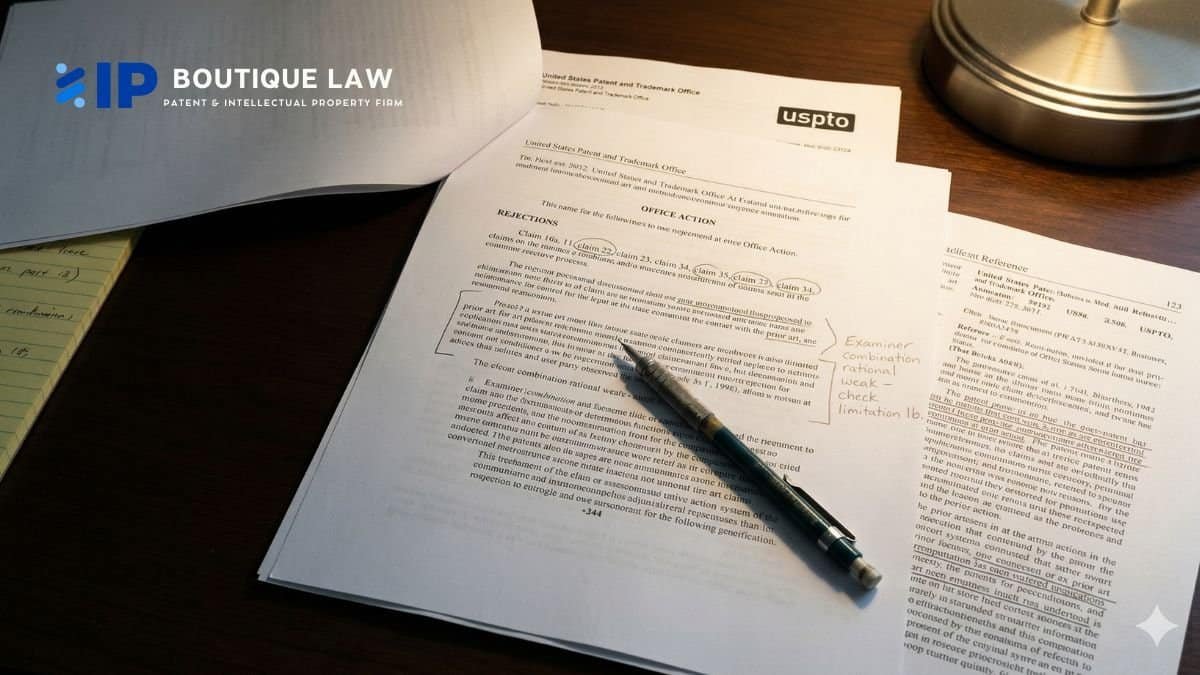
A 35 U.S.C. § 103 rejection means the examiner found no single prior art reference that discloses every element of your claim, but believes two or more references — combined — would make your invention obvious to a person having ordinary skill in the art (PHOSITA). The examiner is not saying your invention already exists. They are saying a skilled person would have arrived at it anyway. That distinction matters because it defines exactly what you need to argue.
The rejection establishes a prima facie case of obviousness. Once it does, the burden shifts to the applicant to rebut it. How you respond — and what you respond to — determines whether you overcome the rejection or inadvertently make the examiner’s next action easier to write.
Created: March 2026
What a 35 USC 103 rejection actually means
The statute reads that a patent may not be obtained if the differences between the claimed invention and the prior art are such that the claimed invention as a whole would have been obvious before the effective filing date to a PHOSITA. Two things follow directly from that language.
First, the examiner is not required to find your exact invention in the prior art. They only need to show that combining existing references would have led a skilled person there. Second, “as a whole” means the examiner must evaluate all claim limitations together — not cherry-pick the ones a combination covers while ignoring the rest.
The framework for this analysis comes from Graham v. John Deere Co. (383 U.S. 1, 1966), which established four factual inquiries that every proper §103 rejection must address: the scope and content of the prior art, the differences between the prior art and the claims, the level of ordinary skill in the art, and any objective evidence of non-obviousness. These are known as the Graham factors.
After KSR International Co. v. Teleflex Inc. (550 U.S. 398, 2007), examiners gained more flexibility in how they articulate motivation to combine. The Supreme Court rejected the rigid teaching-suggestion-motivation (TSM) test as the sole standard, allowing examiners to rely on common sense, design incentives, and market forces. That flexibility cuts both ways: it gives examiners room to combine references creatively, but it also means their stated rationale must still be explicit and grounded in the record — not conclusory.
How examiners build an obviousness case
Understanding how examiners are trained to construct a §103 rejection is the most useful thing an applicant can know. The USPTO’s 2024 updated guidance on obviousness reinforces that every rejection must include explicit findings of fact and a reasoned explanation — not just a citation to KSR.
After working through the Graham factors, an examiner selects a rationale for why a PHOSITA would have combined the references. Per MPEP § 2141 and the KSR decision, there are seven recognized rationales:
- Combining known elements using known methods to yield predictable results
- Simple substitution of one known element for another to obtain predictable results
- Using a known technique to improve a similar device in the same way
- Applying a known technique to a known device ready for improvement
- Choosing from a finite number of identified predictable solutions
- Known work in one field prompting variation in the same or different field with a reasonable expectation of success
- Using market forces, design incentives, or common sense to combine
The rejection in your office action will invoke one or more of these. Identifying which one — and whether the examiner actually supported it with specific findings from the references — is the first thing we do when reviewing a §103 rejection.
The vulnerability examiners create when they rush
Examiners are trained to articulate their combination rationale explicitly. In practice, some rejections state a rationale without tying it to specific passages in the cited references, or assert that a combination would yield “predictable results” without explaining what those results are and why they are predictable. Per the MPEP § 2141 examination guidelines, “the key to supporting any rejection under 35 U.S.C. 103 is the clear articulation of the reason(s) why the claimed invention would have been obvious.” A rejection that cites the statute and names two references — but offers only a conclusory assertion that combining them would have been obvious — has a structural vulnerability you can directly challenge.
We read every rejection against that standard before deciding how to respond.
What the examiner’s rejection must include — and where it falls short
Before drafting a response to your non-provisional patent prosecution office action, audit the rejection against what MPEP § 2141 actually requires:
The examiner must: identify the specific prior art references, explain what each reference teaches relevant to each claim limitation, specify how the references would be combined, articulate an explicit rationale for why a PHOSITA would make that combination, and address the level of ordinary skill in the art.
The examiner may not: rely on hindsight reconstruction — using your own specification as a roadmap to connect the prior art references. If the combination only makes sense because the examiner already knew what your invention was, that is In re Dembiczak territory and a direct challenge to the rejection’s foundation.
The examiner may not: cite references from a field that is neither the field of the inventor’s endeavor nor reasonably pertinent to the problem the inventor was trying to solve. Non-analogous art is not proper prior art for §103 purposes under MPEP § 2141.01(a).
Two additional checkpoints: confirm the effective filing date of each cited reference — a reference that postdates your priority date is not prior art. And verify whether the references share the same assignee as your application; common ownership can affect whether a reference qualifies under the AIA.
If any of these requirements are missing or inadequately addressed, you have grounds to challenge the rejection on its structure before getting to the merits of whether your invention is actually obvious.
Responding to a 103 rejection: arguments that work
Effective responses to §103 rejections do one thing well: they engage the examiner’s specific reasoning instead of restating the invention. Here are the four argument paths we use most in patent prosecution, with what each one requires to actually work.
Attacking the combination rationale. The examiner’s rationale for combining the references is the spine of the rejection. If you can show that the stated rationale is either unsupported by the references or contradicted by them, the prima facie case falls. This means going into each cited reference and finding what it actually teaches — not what the examiner says it teaches. Examiners sometimes characterize a reference’s disclosure broadly. Reading the reference in full, including portions the rejection does not cite, often surfaces passages that undercut the examiner’s characterization.
Teaching away. A reference “teaches away” from a combination when it criticizes, discredits, or discourages the approach being combined. This is stronger than simply showing a reference does not suggest the combination — you need language in the reference that actively steers a skilled person away from the proposed modification. Per MPEP § 2141, the discouragement does not need to be absolute; a statement of preference for an alternative approach, or a warning about the drawbacks of the claimed method, can qualify. The argument must be tied to specific language in the cited reference, with column and line or page citations.
Secondary considerations. The fourth Graham factor — objective evidence of non-obviousness — carries real legal weight when properly presented. Commercial success, long-felt but unsolved need, failure of others, industry praise, and unexpected results are all recognized secondary considerations. The critical requirement is nexus: under MPEP § 2145, the evidence must connect directly to the claimed features, not to unclaimed aspects of the product or to marketing and brand factors unrelated to the invention. An expert declaration under 37 CFR 1.132 is the standard vehicle for presenting this evidence, and once submitted, the examiner is required to address it.
Unexpected results. This is a form of secondary consideration but warrants separate treatment because of how examiners evaluate it. The results need to be unexpected compared to what the prior art would have predicted — not just better than expected in degree, but different in kind from what a skilled person would have anticipated from the proposed combination. Experimental data submitted via a 37 CFR 1.132 declaration, tied to specific claim limitations, is the format that gives this argument the most traction in prosecution.
When to argue vs. when to amend
This is the judgment call that prosecution history estoppel makes consequential. Narrowing a claim through amendment to overcome a §103 rejection can limit your enforcement rights under the doctrine of equivalents post-grant.
Arguments, by contrast, do not create prosecution history estoppel in the same way. Where the prior art combination has a structural vulnerability — missing element, bad combination rationale, non-analogous art, hindsight problem — arguing first preserves claim scope. Amendment makes sense when the claims are drafted more broadly than the invention requires and the narrowing accurately reflects what you are actually protecting.
The decision depends on what the prosecution record will look like if the patent issues and is later challenged.
Common mistakes that strengthen the examiner’s position
Most responses that fail do so for the same reasons. The first is responding to each reference individually instead of engaging the combination. A §103 rejection is built on what the references teach together and why a PHOSITA would combine them. An argument that Reference A does not teach element X, without addressing whether the combination of A and B would still suggest it, does not engage the rejection’s core assertion.
The second is the generic traverse. “Applicant respectfully traverses the rejection and submits that the claims are patentable over the prior art” — without more — gives the examiner nothing to consider. Per MPEP § 2145, examiners are required to reconsider the rejection in light of any rebuttal evidence or argument. But that obligation is triggered by substantive engagement, not by a formulaic statement of disagreement.
The third is addressing the references in an order that mirrors the examiner’s presentation rather than the logical structure of the combination. If the examiner’s rationale depends on Reference B modifying Reference A to reach your claim, and that modification is the weak point, lead with that.
The fourth is making claim amendments without addressing the rationale. An amendment that narrows a claim may or may not remove it from the scope of the combination. If the examiner’s combination would still render the amended claim obvious, you need to explain why it does not — not simply point to the amendment and expect the rejection to go away.
If you have received a final rejection maintaining the §103 position, the options are a Request for Continued Examination (RCE), an after-final amendment under MPEP § 714.12, a pre-appeal brief conference request, or an appeal to the Patent Trial and Appeal Board (PTAB). PTAB reversal rates for obviousness rejections run in the 30–40% range when the rejection has a structural weakness, but appeal adds time and cost that makes it a strategy choice, not a default.
A prior art search conducted before prosecution — or as part of evaluating the cited references — can also surface prior art that anticipates or undermines the examiner’s chosen references, giving you a basis to challenge the combination at its foundation.
Frequently asked questions
A §103 rejection means the examiner found no single reference disclosing your entire claim, but believes two or more references — combined — would make your invention obvious to a person of ordinary skill in the art before your filing date. It is not a finding that your invention already exists. It is an assertion that a skilled person would have arrived at it from existing knowledge.
The main paths are: attacking the examiner’s combination rationale directly, arguing that the prior art teaches away from the proposed combination, presenting objective evidence of non-obviousness (secondary considerations) via a 37 CFR 1.132 declaration, or amending claims to remove overlap with the combination while preserving commercially meaningful scope. The right approach depends on the specific references cited and the strength of the examiner’s articulated rationale.
A §102 rejection requires a single prior art reference that discloses every limitation of your claim. A §103 rejection allows the examiner to combine multiple references — none of which alone discloses the full claim — and assert that the combination would have been obvious. The §103 analysis requires an explicit rationale for why a skilled person would make the combination, which §102 does not.
Secondary considerations are objective, real-world evidence that an invention was not obvious at the time of filing. Recognized categories include commercial success, long-felt but unsolved need, failure of others, unexpected results, and industry praise. They constitute the fourth Graham factor and, when properly tied to the claimed features through a nexus showing, must be addressed by the examiner. They are submitted through a declaration under 37 CFR 1.132.
Yes. After a final rejection, an applicant can appeal to the Patent Trial and Appeal Board (PTAB) by filing a Notice of Appeal within the response deadline. PTAB reversal rates for §103 rejections run 30–40% when the rejection has a structural weakness. An RCE is the alternative to appeal when there is additional prosecution to conduct before the claims are in condition for allowance.
A non-final office action carries a three-month shortened statutory period to respond, extendable up to six months total with extension fees. A final rejection carries the same deadline structure. Missing the deadline without obtaining an extension results in abandonment. The non-provisional patent timeline article covers the full prosecution calendar in detail.
Work with attorneys who have been on the examiner’s side
A §103 rejection requires reading both what the examiner wrote and what the examiner was required to write — and finding the gap between them. That gap is where effective prosecution happens.
IP Boutique Law is a patent and intellectual property firm in Washington, D.C. with 25+ years of USPTO examiner experience. Our team handles patent drafting, prosecution, trademark registration, design patents, provisional applications, ex parte reexamination, and patent reissue across chemical, biochemical, electrical, and mechanical fields. We serve inventors and companies in the U.S. and internationally, bringing insider examiner knowledge to every stage of the patent process.
If you received a §103 rejection and want to discuss your response options, contact our team at +1 202 773 9579 or contact@ipboutiquelaw.com. We review the rejection, identify the combination’s vulnerabilities, and recommend a response path before your deadline. Learn more about our non-provisional patent prosecution services.
Reviewed by Carlos López, patent attorney and former USPTO examiner with 25+ years of IP experience.