

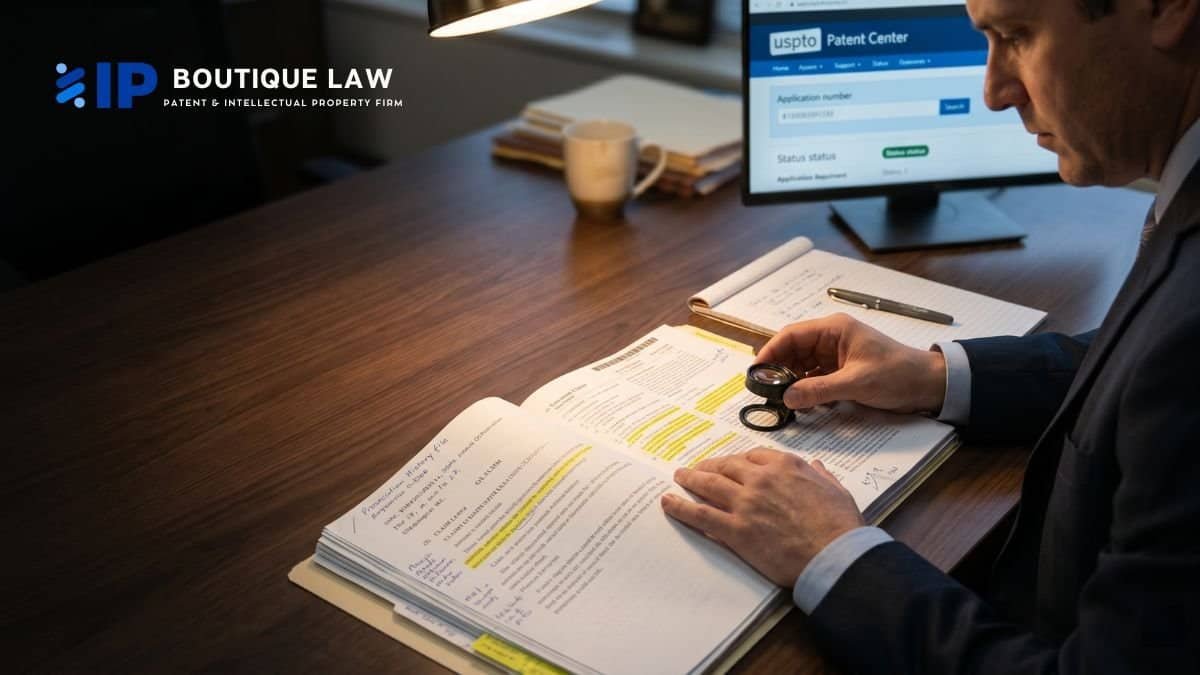
A patent reissue runs $5,000 to $10,000 in attorney fees at our firm, plus USPTO government fees that range from roughly $982 to $4,610 depending on entity size. That total is higher than most patent holders expect — and the reason comes down to a fundamental difference in how examiners approach reissue prosecution vs. an original application. Our patent reissue attorney team works through reissue prosecution regularly, and the cases that stall or exceed budget almost always share the same underestimated cost drivers.
The USPTO’s current fee schedule, effective January 19, 2025 and last revised June 1, 2026, sets the reissue examination fee at $2,550 for large entities, $1,020 for small entities, and $510 for micro entities. For comparison, the utility examination fee for an original application is $880 for large entities. That nearly 3x difference in the examination fee alone signals how the USPTO itself categorizes reissue prosecution: more intensive, not a straightforward re-review.
Created: May 2026
What patent reissue costs in 2026: the complete breakdown
The full cost has two components: USPTO government fees and attorney fees. Neither is optional, and both vary by entity classification and case complexity.
USPTO reissue government fees (2026)
The table below reflects fees from the USPTO fee schedule, last revised June 1, 2026. All reissue applications require the basic filing fee, the reissue search fee, and the reissue examination fee at the time of filing. The reissue issue fee is paid after the Notice of Allowance.
| Fee | Large Entity | Small Entity | Micro Entity |
|---|---|---|---|
| Basic filing fee (37 CFR 1.16(e)) | $350 | $140 | $70 |
| Reissue search fee (37 CFR 1.16(n)) | $770 | $308 | $154 |
| Reissue examination fee (37 CFR 1.16(r)) | $2,550 | $1,020 | $510 |
| Reissue issue fee (37 CFR 1.18(a)) | $1,290 | $516 | $258 |
| Total government fees (through issuance) | $4,960 | $1,984 | $992 |
Additional fees apply for excess claims (more than 20 total or more than 3 independent), application size over 100 pages, or extension of time during prosecution. These are not included in the base table because they depend on the specific application.
One fee that catches clients off guard: maintenance fees on the original patent do not stop during the reissue pendency. Under MPEP § 1415.01, the filing of a reissue application does not alter the maintenance fee schedule for the original patent. If the patent expires because maintenance fees were not paid, the reissue cannot be granted — 35 U.S.C. 251 only permits reissue for the unexpired term. Budget for maintenance fees as a parallel cost.
Attorney fees: $5,000 to $10,000 — what drives the range
Our reissue application prosecution fees run $5,000 to $10,000. That range reflects real differences across cases, not arbitrary pricing.
Cases toward the lower end typically involve narrowing reissues with straightforward error correction — a drafting mistake in the specification, claims narrower than the disclosed invention supports, or a clear error that examiners won’t dispute.
Cases toward the upper end involve broadening reissues, complex claim restructuring, multiple office action rounds, or cases where the original prosecution history creates recapture risk (explained in detail in the next section). Broadening reissues are inherently more attorney-intensive because every proposed change requires analysis against the entire original prosecution record.
The two-year window matters here. Under 35 U.S.C. § 251, a reissue application seeking to broaden patent claims must be filed within two years of the original patent grant. Filing within that window does not guarantee allowance of broader claims, but missing the window closes the broadening option entirely. Cases filed near the deadline with complex broadening strategies require more front-loaded attorney work.
Why reissue prosecution costs more than original prosecution
This is the section most cost guides skip, and it’s where the real difference lives.
When you file an original non-provisional patent application, the examiner reviews your claims against the prior art with no prior prosecution history to consider. You start clean. In a reissue, the examiner does not start clean — and under MPEP § 1445, a reissue application is examined in the same manner as an original application, with one critical addition: claims in a reissue application carry no presumption of validity.
That distinction has direct cost consequences.
In original prosecution, claims carry a presumption that they were validly granted. In reissue, the examiner resets that presumption. Every claim is open to rejection on prior art grounds, regardless of whether that prior art was considered during the original examination. A reference that the original examiner reviewed and passed over can become a new rejection in reissue.
The recapture doctrine adds another layer. Under MPEP § 1412.02, when a patent holder seeks to broaden claims through reissue, the examiner applies a three-step test drawn from North American Container v. Plastipak Packaging (Fed. Cir. 2005) to determine whether the proposed broader claims attempt to recapture subject matter surrendered during the original prosecution. The test requires the examiner to:
- Determine whether the reissue claims are broader than the original patent claims
- Determine whether the broader aspects relate to subject matter surrendered in the original prosecution
- Determine whether the reissue claims were materially narrowed in other respects to avoid recapture
Examiners must review every argument, amendment, and claim change from the original prosecution history to apply this test. For patents with complex prosecution histories — multiple office action rounds, claim amendments tied to specific prior art rejections, arguments distinguishing prior art — that review is substantial. The attorney work on the response side mirrors it: every proposed broadening must be mapped against the full original prosecution record to avoid a recapture rejection.
Recapture rejections have high affirmance rates at the Patent Trial and Appeal Board. Cases that reach PTAB on recapture grounds typically do not resolve in the applicant’s favor. The front-loaded attorney work to avoid that outcome is not optional; it’s the prosecution strategy.
For patent holders comparing reissue to original patent prosecution, the complexity difference is concrete: original prosecution is a forward-looking exercise, and reissue prosecution is both forward-looking and backward-looking simultaneously.
Cost factors most attorneys underestimate
Several cost drivers consistently surprise patent holders who have gotten a rough estimate from a general patent attorney without reissue-specific experience.
Maintenance fees during pendency. As noted above, original patent maintenance fees run in parallel with the reissue proceeding. If the patent is around the 3.5-year or 7.5-year maintenance window, that payment falls due regardless of whether the reissue is still pending. Large entities pay $2,000 at the 3.5-year mark, $3,760 at 7.5 years. These fees are separate from reissue costs and must be tracked independently.
Request for Continued Examination (RCE) fees. If prosecution extends beyond the initial examination cycles — common in broadening reissues with recapture issues — an RCE may be necessary. The current RCE fee is $1,500 for a first RCE (large entity), with second and subsequent RCEs running $2,860. Factor in attorney time for preparing the RCE submission on top of the government fee.
Extension of time fees. Office action response deadlines in reissue are three months without extension fees. The first month of extension runs $235 for large entities, $94 for small entities. Extensions are sometimes unavoidable in complex reissue cases where the prosecution history requires thorough analysis before responding. Budget $300 to $1,600 in potential extension fees depending on entity size and how many months are needed.
Petitions. Certain procedural issues in reissue require petitions with their own fees and attorney time. These are case-specific and harder to predict upfront, but patent holders with unusual situations in their original prosecution history — inequitable conduct concerns, co-inventorship questions, or applications involving certificates of correction — should ask about petition risk before filing.
The aggregated effect of these factors means the realistic all-in cost for many reissue cases lands closer to the upper range of the $5,000-$10,000 attorney fee estimate, not the lower end.
Timeline and its cost implications
Patent reissue prosecution takes 2 to 3 years from filing to issuance in most cases, as of 2026. That timeline is not uniform — it depends on the technology area, the complexity of the claim changes, and whether office actions are issued.
The typical reissue prosecution progression:
- Preparation and filing (1-3 months): Application drafted, prosecution history analyzed, reissue oath or declaration prepared, claims structured. This is the front-loaded phase for broadening reissues.
- USPTO docketing and first action (12-18 months after filing): The application is assigned to an examiner. First office actions in reissue often come later than in original prosecution because the examiner must review the full original prosecution record.
- Office action response (3-6 months per round): Each round requires analysis of the rejection, claim amendments or arguments, and a written response. Attorney fees accumulate here. For the office action response process in detail, see our guide on how to respond to a patent office action.
- Allowance and issue (3-6 months): After allowance, the issue fee is paid and the reissue patent issues.
For context on how this compares to original patent prosecution, our non-provisional patent timeline article covers the typical 24-36 month range for standard utility applications. Reissue falls in a similar overall window, but the distribution of attorney work is different — more concentrated at the beginning (prosecution history analysis) and more intensive per office action round.
A longer timeline means attorney fees that may span two to three billing years. For cases where time-to-allowance is a business concern — a competitor is already in the market with a product that would infringe broader claims — ask specifically about prosecution strategy, not just total cost.
When reissue investment makes sense
The cost of a reissue has to be measured against what a defective patent actually costs you.
A patent with claims that are too narrow may be technically valid but commercially ineffective. If competitors are designing around your claims by omitting one specific limitation — and the original prosecution history does not make that limitation unavoidable — a broadening reissue can restore the commercial scope you intended to protect. The investment question is whether the broadened claims, if allowed, would meaningfully change your enforcement position.
| Scenario | Reissue worth pursuing? |
|---|---|
| Claims too narrow to cover competitor products | Likely yes, if filed within 2 years of grant |
| Specification error renders claims invalid | Yes — narrowing reissue to correct |
| Competitor already designing around patent | Evaluate broadening reissue urgency |
| Patent near expiration | Probably not — reissue only covers unexpired term |
| Error is inventorship only | No — certificate of correction is faster and less costly |
| Claims broad enough but prosecution history is weak | Consider reexamination instead |
For the last scenario — cases where the concern is validity rather than scope — ex parte reexamination addresses a different problem. Reissue corrects the patent’s errors. Reexamination addresses prior art validity challenges. Choosing the wrong vehicle wastes both time and money.
A reissue makes practical sense when: the original error is real and documentable as inadvertent, the corrected claims would produce commercial value that justifies the 2-3 year investment, and the original prosecution history does not contain surrender-generating limitations that block the proposed changes.
FAQs
A patent reissue costs $5,000 to $10,000 in attorney fees at IP Boutique Law, plus USPTO government fees ranging from approximately $992 (micro entity) to $4,960 (large entity) through issuance. Total all-in cost typically falls between $6,000 and $15,000 depending on entity size, case complexity, and whether multiple office action rounds are required. Broadening reissues tend toward the higher end due to recapture doctrine analysis.
The USPTO reissue application requires three fees at filing: a basic filing fee ($70 micro / $140 small / $350 large entity), a reissue search fee ($154 micro / $308 small / $770 large entity), and a reissue examination fee ($510 micro / $1,020 small / $2,550 large entity). The reissue issue fee ($258 micro / $516 small / $1,290 large entity) is paid after allowance. Source: USPTO fee schedule, last revised June 1, 2026
Patent reissue prosecution typically takes 2 to 3 years from filing to issuance, as of 2026. The timeline includes USPTO docketing (which can run 12-18 months before a first office action in reissue), office action response rounds (3-6 months each), and post-allowance issuance (3-6 months). Cases with complex broadening strategies or recapture issues may take longer. The timeline is comparable to original utility patent prosecution but with more intensive early preparation work.
Yes, but only if the broadening reissue application is filed within two years of the original patent grant date, per 35 U.S.C. § 251. The examiner will apply the recapture doctrine to determine whether proposed broader claims attempt to reclaim subject matter surrendered during the original prosecution. Claims that were narrowed by amendment or argument to overcome rejections may be blocked from broadening under recapture rules. A thorough prosecution history review is required before filing.
A reissue is worth pursuing when the original patent error is real and documentable as inadvertent, the corrected or broadened claims would improve your enforcement position against competitors, and sufficient patent term remains to justify the 2-3 year prosecution timeline. It is generally not cost-effective for patents near expiration, cases involving inventorship errors only (a certificate of correction is less costly), or situations where the concern is prior art validity rather than claim scope.
A patent reissue under 35 U.S.C. § 251 can correct errors that made the patent wholly or partly inoperative or invalid — including claims that are too broad or too narrow, defective specifications or drawings, and failure to claim all disclosed embodiments. The error must be inadvertent, without deceptive intent. Reissue cannot correct inequitable conduct, extend patent term, or add new matter not in the original disclosure. Minor typographical errors are better addressed through a certificate of correction.
A patent reissue corrects errors in an issued patent — including broadening or narrowing claims — and can only be initiated by the patent owner. Ex parte reexamination addresses prior art validity challenges based on patents or printed publications, and can be requested by the patent owner or a third party. Reissue is the right tool for scope corrections; reexamination addresses whether the patent should have issued given prior art. The two proceedings involve different fees, timelines, and strategic considerations.
Getting a specific estimate for your case
The $5,000-$10,000 attorney fee range describes what reissue prosecution typically costs — it does not describe what your case will cost before we review the patent and its prosecution history. Cases at the lower end have clean, narrow errors. Cases at the upper end have complex broadening strategies, contentious prosecution records, or multiple office action rounds.
IP Boutique Law is a patent and intellectual property firm in Washington, D.C. with 25+ years of USPTO examiner experience. Our team handles patent drafting, prosecution, trademark registration, design patents, provisional applications, ex parte reexamination, and patent reissue across chemical, biochemical, electrical, and mechanical fields. We serve inventors and companies in the U.S. and internationally, bringing insider examiner knowledge to every stage of the patent process.
To get a cost estimate tied to your specific patent and situation — not a generic range — contact us at +1 202 773 9579 or contact@ipboutiquelaw.com. We review the patent and its prosecution history before quoting, so the number we give you reflects what the work actually requires.
Reviewed by Carlos López, patent attorney and former USPTO examiner with 25+ years of IP experience.