

A patent qualifies for reissue only when it is, through error, wholly or partly inoperative or invalid because of a defective specification, drawing, or claim scope. That standard comes directly from 35 U.S.C. §251, and it rules out a lot of what patent owners assume counts. A misspelled word or a typo does not qualify. A claim that turned out to be too narrow, a specification that left out a necessary embodiment, or a drawing that failed to show a claimed feature clearly, these do. Our patent reissue services exist precisely because these categories of error show up in issued patents more often than most owners expect.
Examiners see the same handful of mistakes repeat across reissue filings. Most trace back to decisions made during the original prosecution, often under deadline pressure or without full visibility into how the claims would hold up once the patent was enforced. Per MPEP §1402, the most common bases for filing a reissue application are claims that are too narrow or too broad, inaccuracies in the disclosure, foreign priority errors, and failure to reference prior copending applications.
Below, we break down what each of these looks like in practice, plus two categories examiners handle constantly that don’t always make the standard lists: inventorship errors and dependent claim defects.
Last updated: July 2026
Claim scope errors: when claims are too narrow or too broad
Claim scope errors are the single most common reason patent owners file for reissue, and they run in two opposite directions. Claims drafted too narrowly leave commercial embodiments of the invention unprotected. Claims drafted too broadly can render the patent vulnerable to invalidity challenges the owner didn’t anticipate at filing.
Narrow claims usually happen for a defensible reason: the attorney added limitations during prosecution to distinguish the invention from cited prior art. The problem surfaces later, once a competitor’s product falls just outside the claim boundary the original attorney drew. A reissue filed within two years of the original grant can broaden those claims back out, subject to §251’s two-year window for broadening reissues.
That is where the recapture doctrine sets a hard limit. Under MPEP §1412.02, a patent owner cannot use reissue to reclaim scope that was deliberately surrendered during original prosecution to overcome a rejection. Examiners apply a three-step test to catch this:
- Whether, and in what respect, the reissue claims are broader than the original patent claims
- Whether that broader scope relates to subject matter surrendered during prosecution
- Whether the reissue claims were narrowed enough in other respects to avoid recapture despite the broadening
Having applied this test from the examiner’s side, we know the review goes past the claim language itself. It reaches into the full prosecution history, including arguments made only in response to an office action and never reflected in an amendment. A limitation argued away to secure allowance stays surrendered even if it was never actually written into the claim.
Broad claims create a different failure mode. When claim language outruns what the specification actually supports, examiners reject on enablement or written description grounds under §112. A reissue to narrow overly broad claims doesn’t face the recapture problem, but it does need to happen before an infringer challenges validity in litigation, where the same defect becomes a weapon.
Specification defects and inadequate disclosure
A specification qualifies as defective for reissue purposes when it fails to enable the full scope of what the patent claims, or when it omits detail an examiner would have required had the gap been caught during original prosecution. This is the second most common basis under MPEP §1402, and it tends to surface only after the patent is asserted or licensed, when someone finally reads the specification looking for support that isn’t there.
The recurring pattern we see: applicants describe one working embodiment in detail, then claim broadly enough to cover variations that were never actually disclosed. The claims read fine on their own. The specification doesn’t back them up. Examiners are trained to catch this during original examination, but a specification that describes the invention adequately for a narrow claim set can still fall short once broader claims get added later in prosecution without a matching update to the written description.
Reissue can add disclosure that was implicit in the original filing but never spelled out explicitly, provided no new matter gets introduced. That last part is the constraint that trips up most attempts: 37 CFR 1.173 prohibits adding anything to a reissue specification that wasn’t already supported by the original patent.
If the missing detail genuinely wasn’t there in any form, reissue can’t manufacture it after the fact. Prevention starts at the drafting stage, which is why our non-provisional patent requirements guide covers what a specification needs to support the claim scope an applicant actually wants.
Drawing errors that affect claim interpretation
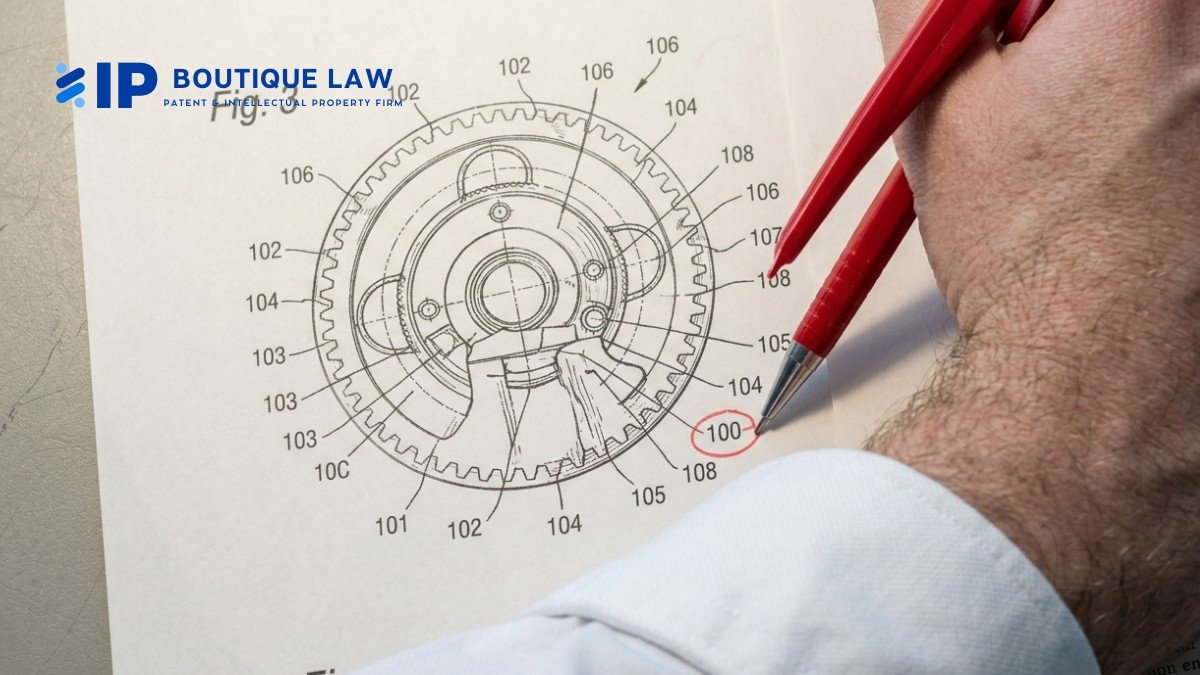
Drawing errors create reissue-worthy defects when the figures fail to show a structural feature the claims depend on, or when inconsistencies between the drawings and the written description leave an examiner (or a court, later) uncertain what the claim actually covers. Under 37 CFR 1.173, a reissue application must include a clean copy of every drawing sheet from the original patent, and any changes to those drawings have to be made through the formal amendment process, not simply resubmitted as corrected figures.
Three drawing problems account for most of what we see in reissue filings:
- Missing views. A claimed feature exists only in the written description, with no corresponding figure. Examiners need the drawings to confirm structural claim language actually matches what was invented.
- Reference number mismatches. A part labeled one way in the specification appears under a different number in the figures, creating ambiguity about which structure a claim term refers to.
- Inconsistent embodiment depiction. The drawings show one version of the invention while the claims, read literally, describe a different configuration, leaving the scope of protection unclear.
None of these are typographical. Each one affects what the patent actually covers, which is exactly the standard §251 requires for reissue eligibility. A patent with clean claim language but drawings that don’t support it is still, in the examiner’s eyes, wholly or partly inoperative.
Correcting inventorship through reissue
Reissue can correct inventorship, but it isn’t always the right tool for it. Under MPEP §1412.04, a reissue application is the appropriate vehicle only when the correction goes beyond a simple, uncontested fix. If every party agrees on the change and inventorship is the only issue, a certificate of correction under 35 U.S.C. §256 handles it faster and without reopening the rest of the patent to examination.
| Situation | Correct mechanism |
|---|---|
| All parties agree; inventorship is the only change needed | Certificate of correction (§256) |
| Inventor disputes the correction, or an assignee wants to change inventorship without unanimous inventor consent | Reissue application |
| Inventorship correction accompanies a claim scope change | Reissue application (all inventors must sign) |
| Minor clerical error not affecting claim scope | Certificate of correction, not reissue |
Where an assignee holds the entire interest in a patent and believes the named inventors are incorrect, the assignee can file a reissue to correct inventorship even without that inventor’s agreement, provided the required consent and ownership documentation is filed. This authority comes from 35 U.S.C. §118, and it’s a mechanism most patent owners don’t know exists until a dispute makes it necessary. Misjoinder correction under Ex parte Scudder works the same way when 35 U.S.C. §256 isn’t adequate to resolve a contested case.
Dependent claim relationship errors
Dependent claim errors happen when a claim’s antecedent basis breaks down, when a dependent claim contradicts a limitation in the claim it depends from, or when claim numbering gets scrambled during a late-stage amendment and never gets caught before issuance. Examiners flag antecedent basis problems constantly during original prosecution under §112(b) indefiniteness review, but errors introduced in a final round of claim amendments sometimes slip past that review before the patent issues.
A few patterns recur:
- A dependent claim references “the sensor” when the independent claim only introduced “a detection element,” leaving no clear antecedent for the term
- A dependent claim adds a limitation that narrows a feature the independent claim already defined in a way that makes the dependent claim logically impossible to satisfy
- Renumbering during a late amendment leaves a dependent claim pointing to the wrong parent claim number in the issued patent
These errors are correctable by reissue because they affect claim scope and enforceability, not just readability. A dependent claim with broken antecedent basis is arguably indefinite, and an indefinite claim is, by definition, one where the patentee hasn’t clearly stated what they have the right to claim. That gap is exactly what our patent reissue vs. reexamination comparison walks through in more detail, since the same defect sometimes gets addressed through either proceeding depending on whether new prior art is also in play.
Prevention strategies: what examiner-level review catches before filing
The gap between a patent that needs reissue and one that doesn’t usually traces back to how the original application was reviewed before filing, not to anything that happened during examination itself. Our non-provisional patent prosecution work applies the same scrutiny an examiner would bring, before the application ever reaches the USPTO.
That review follows a consistent sequence:
- Cross-check every claim term against the specification to confirm explicit support exists, not just implied coverage
- Verify every dependent claim’s antecedent basis traces cleanly back to its parent claim
- Confirm the drawings show every structural feature the claims reference, with consistent reference numbers throughout
- Flag any claim amendment made late in prosecution to overcome a rejection, since that language becomes surrender-generating material if a broadening reissue is ever needed
- Review foreign priority claims and copending application references for accuracy before the patent issues, not after
Having issued rejections for these exact defects as examiners, we know which ones are genuinely hard to catch and which ones simply get missed under time pressure. Antecedent basis and drawing consistency fall into the second category. They are checkable with a careful pass through the application, and catching them before filing costs a fraction of what a reissue costs after the fact.
The reissue mistakes clients ask about most
Yes, within two years of the original patent’s grant. A broadening reissue can add back claim scope that was never pursued, as long as the recapture doctrine doesn’t bar it. If the narrow scope resulted from an argument made to overcome a prior art rejection, that specific scope generally cannot be recaptured, even within the two-year window.
Only if the inaccuracy affects claim scope or enforceability. Spelling and grammatical errors don’t meet the §251 standard on their own. A specification that fails to support the claimed scope, or that omits a disclosed embodiment needed to interpret the claims, does qualify.
Narrowing reissues have no fixed deadline, though diligence matters for enforceability against parties who relied on the original claim scope. Broadening reissues must be filed within two years of the original patent’s grant date, with no extensions available under 35 U.S.C. §251.
Yes, when the drawings fail to depict a claimed structural feature or create ambiguity about claim scope. Purely cosmetic drawing issues that don’t affect how a claim reads generally don’t meet the reissue standard.
A certificate of correction works when every party agrees and inventorship is the only issue. A reissue becomes necessary when the correction is contested, when an assignee needs to change inventorship without full inventor consent, or when the inventorship fix comes bundled with a claim scope change.
Sometimes not. Antecedent basis problems are a standard part of §112(b) examination, but errors introduced in a late claim amendment, close to allowance, occasionally reach issuance before anyone catches them. Reissue remains available once they’re discovered.
Getting reissue-eligible errors caught early
The errors that drive most reissue filings, claim scope drawn too narrow or too broad, specification gaps, drawing inconsistencies, inventorship disputes, and broken dependent claim relationships, share a common thread. Each one was reviewable before the patent issued, by someone applying the same standard an examiner would apply during prosecution.
IP Boutique Law is a patent and intellectual property firm in Washington, D.C. with 25+ years of USPTO examiner experience. Our team handles patent drafting, prosecution, trademark registration, design patents, provisional applications, ex parte reexamination, and patent reissue across chemical, biochemical, electrical, and mechanical fields. We serve inventors and companies in the U.S. and internationally, bringing insider examiner knowledge to every stage of the patent process.
If a granted patent has claim scope, specification, or drawing issues that need correcting, let’s talk through whether reissue is the right path and what the filing would need to include. Reach our team at +1 202 773 9579, email contact@ipboutiquelaw.com, or schedule a consultation through our website.
Reviewed by Carlos López, patent attorney and former USPTO examiner with 25+ years of IP experience.