

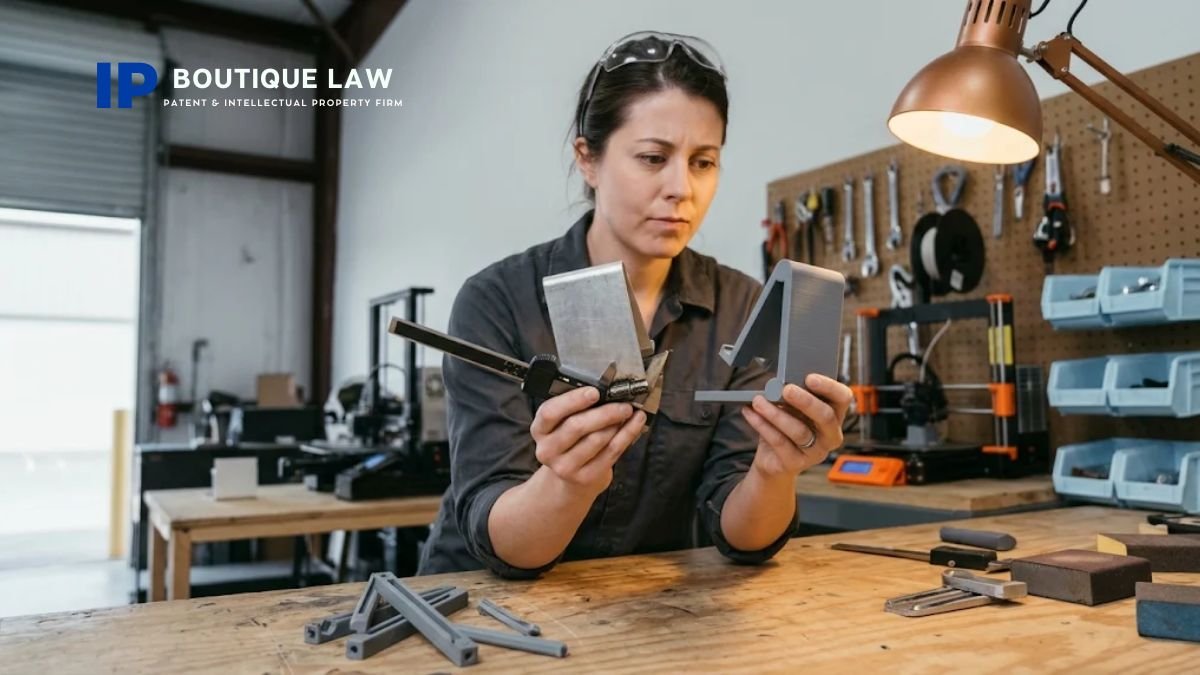
A patent search is a structured review of granted patents, published applications, and technical literature to find out if your invention, or something close enough to block it, already exists. You are not legally required to run one before filing. The USPTO, though, runs its own search on every utility application, and the examiner’s version goes much deeper than what most inventors do at home. Our patent search attorney team searches the way examiners do, because that is the search your application will eventually face.
That examiner search is not free. Under the USPTO fee schedule, the utility search fee is $770 for large entities, $308 for small entities, and $154 for micro entities (as of November 2026), paid at filing on top of the filing and examination fees. Every applicant pays for a search. The real question is whether you see the results before you spend money on drafting or only in a first office action.
Having worked inside the USPTO, we know examiners must cover U.S. patents and publications, foreign patent documents, and non-patent literature. Most free searches cover only the first, which explains why so many inventors are surprised by references they never saw.
Last updated: November 2026
Types of patent searches: novelty, freedom to operate, and validity
There are three main types of patent search, and each answers a different question about patentability, infringement, or another party’s patent. Picking the wrong one is an expensive mistake, because a clean novelty search says nothing about infringement.
| Search type | Question it answers | When to run it | What gets compared | Main focus |
|---|---|---|---|---|
| Novelty (patentability) | Can I get a patent on this? | Before drafting a provisional or non-provisional application | Your invention vs. all earlier public disclosures | What earlier documents describe |
| Freedom to operate (FTO) | Can I make and sell this without infringing? | Before launch, manufacturing, or entering a new market | Your product vs. the claims of patents in force | Live claims, country by country |
| Validity (invalidity) | Would this granted patent survive a challenge? | When a patent is asserted against you, or before buying or licensing one | The patent’s claims vs. art dated before its filing | References the examiner never cited |
Novelty (patentability) search
A novelty search compares your invention with everything made public before your filing date. It looks at what documents disclose, not at what they claim, so a patent that expired twenty years ago can still defeat novelty. The result shows which features are new, and that shapes how the claims should be written.
Freedom to operate search
A freedom to operate search reverses the perspective. It reads the claims of patents still in force in the countries where you plan to make or sell the product. Expired patents drop out, and the exact wording of each claim matters more than the description. You can hold a patentable invention and still infringe someone else’s patent, which is why FTO is a separate search with a separate analysis.
Validity search
A validity search targets one granted patent, usually one asserted against you or one you plan to license, and looks for prior art the examiner missed. If the search turns up a strong reference, the results can support an ex parte reexamination request, which asks the USPTO to review the patent’s claims against that new art.
It is the most demanding of the three searches, because the easy references were already considered during prosecution.
How patent examiners search for prior art, and why inventors miss it
Examiners search from the claims outward, using classification systems, internal databases, and specialized searchers the public does not have. Inventors usually search with product keywords, and the two methods find different documents.
According to MPEP § 904, the examiner must first understand the invention as claimed and then cover three reference sources, and none of them can be dropped without a justification. A typical examiner search follows this order.
- Read the claims and specification to list every element that has to be found in the prior art.
- Define the field of search, including analogous arts where engineers solved a similar problem.
- Search by Cooperative Patent Classification (CPC) codes, which group documents by technical subject regardless of the words they use.
- Run Boolean and proximity queries in PE2E Search, the examiners’ internal tool, which holds more than 69 million foreign patent documents with English machine translations.
- Run Similarity Search, an AI feature examiners have been required to use on utility and plant applications since an October 2025 USPTO memorandum.
- Ask the Scientific and Technical Information Center (STIC) for help with journals, conference papers, and other non-patent literature.
- Record every database, classification, and query in the file’s Search Notes, which become part of the public record.
What counts as prior art under 35 U.S.C. § 102
Under 35 U.S.C. § 102, prior art includes anything patented, described in a printed publication, in public use, on sale, or otherwise available to the public before your effective filing date. That covers a Korean patent, a university thesis, or a trade show demo.
Your own disclosure made one year or less before filing generally does not count against you in the U.S., but many foreign offices, including the European Patent Office, offer no such grace period.
Why inventor searches come up empty
When an inventor tells us a search found nothing, the usual cause is vocabulary. A patent drafter describes a phone stand as a “support apparatus for a portable electronic device,” and a keyword search for “phone stand” will skip right past it. We see these four gaps again and again.
- Searching product names instead of the functional language patent drafters use
- Stopping at U.S. documents, when the closest reference is often a Japanese, German, or Chinese publication
- Skipping non-patent literature, which matters most in software, biotech, and chemistry
- Reading abstracts only, while examiners cite whatever passage or drawing in the full text discloses the claimed element
A reference that surfaces after filing usually means amending claims in an office action response, which we cover in our guide on how to respond to a 35 USC 102 rejection. Found before drafting, the same reference costs nothing more than a better-written application.
USPTO search tools and free alternatives compared with a professional search
Patent Public Search, the USPTO’s free tool, opens the same U.S. collections examiners search, but not the same features. Its own FAQ page states that it does not use semantic searching and has no access to foreign patent databases. These are the main free options as of November 2026.
- Patent Public Search covers granted U.S. patents in full text from 1971, pre-grant publications from March 2001, and OCR-scanned patents from 1836 through 2000.
- CPC classification searching finds documents by technical category, and the USPTO’s multi-step search strategy shows how to combine it with keyword searching.
- Google Patents and Espacenet add foreign documents and machine translation, with weaker field-specific searching.
- Patent and Trademark Resource Centers (PTRCs) have staff trained on USPTO tools, though they cannot give legal opinions.
The USPTO’s ASAP! pilot, which sent applicants up to 10 AI-ranked references before examination, is now closed to new petitions.
| Feature | Free self-search | Professional search |
|---|---|---|
| Patent databases | Patent Public Search, Google Patents, Espacenet | Public and commercial patent databases |
| Foreign documents | Partial, depends on the tool | Searched and reviewed in translation |
| Non-patent literature | Rarely searched | Searched by technical field |
| CPC classification | Possible, with a steep learning curve | Standard practice |
| Claim-element analysis | None | Element-by-element mapping |
| Legal assessment | None | Patentability assessment by a registered practitioner |
| Cost | $0 plus your time | $1,000 to $3,000 at our firm |
A free search is good at killing an idea early, and finding your exact invention in a granted patent saves the drafting cost. A clean free search does not prove novelty, though, and it should not be the only basis for an application that can cost thousands to draft.
What a professional patent search report includes
A professional search report shows what was searched, what was found, and what it means for the claims you can obtain. That last part matters most when we draft a non-provisional patent application, because the closest references mark the boundary your claims must stay outside of.
A complete report from our team contains six parts.
- A short summary of the invention as we understood it, so you can confirm the search targeted the right features
- The search strategy, with the databases, CPC codes, query strings, and dates searched
- The closest references, ranked, with the specific columns, paragraphs, or figures that matter
- An element-by-element chart comparing your key features with each reference
- Our assessment of novelty under § 102 and obviousness under § 103
- Drafting recommendations on which features to emphasize and where the claims will need narrower language
The chart is where examiner experience pays off, because it shows the reference combination an examiner is likely to reject on before the examiner builds it. Those findings feed straight into the specification and claims, which we break down in our article on non-provisional patent requirements.
When a patent search is required and when it is recommended
No statute or USPTO rule requires a patent search before filing, and that includes a provisional patent application. Under 37 CFR 1.56, applicants must disclose information they know is material to patentability, but they have no duty to go looking for it.
A search is a business decision, and in these four situations it is usually the right one.
- Before paying to draft any application, when the drafting budget is larger than the cost of the search.
- Before launching or manufacturing a product, which calls for an FTO search in each country where you will sell.
- Before raising money or licensing the technology, since investors and licensees often ask what the prior art looks like.
- When a competitor asserts a patent against you, which calls for a validity search on that specific patent.
Sometimes we advise filing first. If you plan to show the invention at a trade show next week, a provisional application secures the filing date, and the search can follow during the 12-month provisional period to guide the non-provisional.
Patent search cost breakdown for 2026
A professional novelty search at IP Boutique Law costs $1,000 to $3,000, depending on the technology and how crowded the field is. The table places that figure next to the other costs inventors usually weigh it against.
| Item | Cost | What it covers |
|---|---|---|
| Do-it-yourself search | $0 plus your time | U.S. documents, some foreign coverage through Google Patents or Espacenet, no legal analysis |
| Professional novelty search (IP Boutique Law) | $1,000 to $3,000 | Search, report, element mapping, and patentability assessment |
| USPTO utility search fee (large / small / micro entity) | $770 / $308 / $154 | The examiner’s search after filing, with results seen only in an office action |
| FTO or validity search | Quoted after a scope review | Depends on the number of patents, claims, and countries involved |
Timing is the comparison that matters most. A search before drafting costs a fraction of a non-provisional application, which runs $2,000 to $15,000 to draft at our firm. Finding the same reference in a first office action means paying for amendments on claims written without knowing the art.
Patent search questions inventors ask before they file
Yes. Patent Public Search, Google Patents, and Espacenet cost nothing, and a self-search is a good way to rule out ideas that are already patented by someone else. The limits are coverage and interpretation. Free tools miss most non-patent literature, keyword searches skip documents that use different terminology, and none of them tell you whether a close reference makes your claims obvious. Treat a clean self-search as a first screen rather than a patentability opinion.
Google Patents is useful because it covers foreign documents and handles plain-language queries well. It is not the tool examiners use, and its classification and field-specific searching is weaker than the USPTO’s. It also leaves out journals, product literature, and conference papers, which examiners reach through STIC. For a filing decision, we use Google Patents as one source among several and never as the only one.
A similar patent does not automatically end your plans. Compare its claims and disclosure with your invention feature by feature. If your invention adds a technical feature the reference lacks, and that feature solves a real problem, there may still be patentable subject matter. If that patent is still in force, you also need to check whether your product would fall within its claims, which is a freedom to operate question.
You must disclose the references that matter once you file. Under 37 CFR 1.56, inventors and their attorneys have to disclose information they know is material to patentability, usually through an Information Disclosure Statement. You do not have to submit every document you reviewed. Withholding a known material reference can make the patent unenforceable, so we review search results with this duty in mind before filing.
No search tool can find them, including the examiner’s. U.S. applications are generally published 18 months after their earliest filing date, and some are never published when the applicant opts out and does not file abroad. Anything filed within roughly the last 18 months may be invisible. That blind spot is one more reason to file promptly once a search shows your invention is worth pursuing.
Before you spend on drafting, know what the examiner will find
Every utility application gets searched by the USPTO. A search before filing lets you see the closest prior art while you can still shape the claims around it, instead of reading it for the first time in an office action. The right search depends on the decision in front of you, be it filing, launching a product, or answering someone else’s patent.
IP Boutique Law is a patent and intellectual property firm in Washington, D.C. with 25+ years of USPTO examiner experience. Our team handles patent drafting, prosecution, trademark registration, design patents, provisional applications, ex parte reexamination, and patent reissue across chemical, biochemical, electrical, and mechanical fields. We serve inventors and companies in the U.S. and internationally, bringing insider examiner knowledge to every stage of the patent process.
We’re on your team for that decision. Call us at +1 202 7739579, write to contact@ipboutiquelaw.com, or schedule a patent search with our team, and we’ll work out together which search fits your invention and budget.
Reviewed by Carlos López, patent attorney and former USPTO examiner with 25+ years of IP experience.