

A provisional patent application has four required components: a cover sheet, a written description of your invention, drawings where necessary to understand the invention, and the filing fee. That’s the complete list. No formal claims, no oath or declaration, no prior art disclosure. The USPTO will assign a filing date and you gain immediate “patent pending” status.
What most guides skip is this: the written description carries the full legal weight of your provisional. When we review provisional applications before drafting the nonprovisional, the single most common problem we see is a description that tells us what the invention does but not how it works at a level that would support the claims the inventor actually wants. That gap — invisible at filing — costs inventors their priority date 12 months later. At IP Boutique Law, we’ve examined enough applications from both sides of the process to know where these failures start.
Last updated: February 2026
The four components required for a provisional patent application
The USPTO’s requirements for a provisional application under 35 U.S.C. §111(b) are straightforward. Each component serves a specific legal purpose.
Cover sheet (Form PTO/SB/16)
The cover sheet identifies the application as provisional, lists the title of the invention, names all inventors with their residential addresses, provides a correspondence address, and includes attorney or agent information if applicable. Using the USPTO’s official Form PTO/SB/16 is recommended. You can also substitute an Application Data Sheet (ADS), but the cover sheet or ADS must accompany the filing — without it, the USPTO will treat your application as a nonprovisional utility application, which triggers different requirements and higher fees.
One detail that catches inventors off guard: every inventor must be named. If you have co-inventors and omit one, that omission can create inventorship problems when you file the nonprovisional and during any subsequent licensing or litigation.
Written description (specification)
The specification must comply with 35 U.S.C. §112(a) — the same standard that governs nonprovisional applications. This means the description must enable a person skilled in your field to make and use the invention without extensive experimentation. It must also satisfy the written description requirement (demonstrating you actually possessed the invention as of the filing date) and the best mode requirement (disclosing the best version of the invention you know of at the time of filing).
This is the requirement that determines whether your provisional will actually protect you. We cover this in detail in the next section.
Drawings
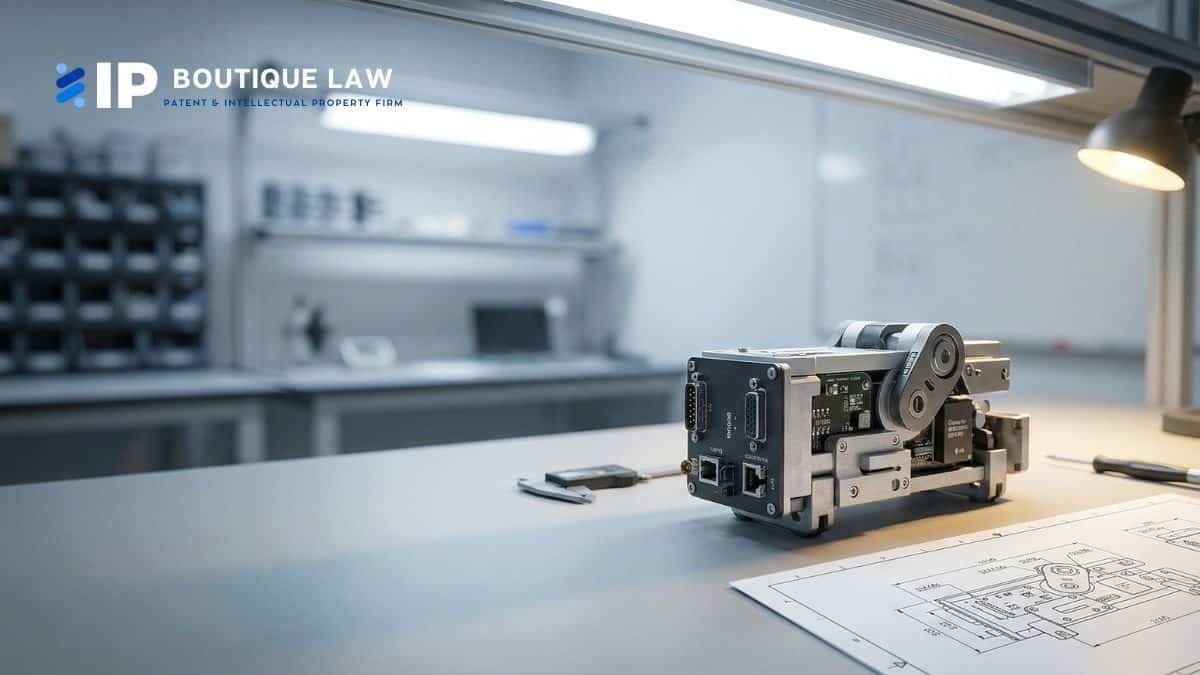
Drawings are not formally required to receive a filing date, but the USPTO’s own guidance states that applicants should file any drawings necessary to understand the invention. The practical rule: if your invention has a physical configuration, a mechanical relationship between parts, or a visual element that the written description alone cannot adequately convey, include drawings. Critically, any drawing necessary to understand your invention cannot be added after the filing date — the prohibition on new matter is absolute. Sketches, CAD files, and photographs are all acceptable formats; formal USPTO drawing standards are not required for a provisional.
Filing fee
Per the USPTO fee schedule effective January 19, 2025 (last revised March 1, 2026):
| Entity type | Provisional filing fee |
|---|---|
| Large entity | $325 |
| Small entity (fewer than 500 employees) | $130 |
| Micro entity | $65 |
Applications exceeding 100 pages incur an additional size fee of $450 per 50-page increment (reduced for small and micro entities). File through USPTO Patent Center electronically — unlike nonprovisional utility applications, there is no non-electronic filing surcharge for provisionals.
Our provisional patent application service ranges from $2,000 to $5,000 in attorney preparation fees, depending on the technical complexity of your invention. This covers complete specification drafting, drawing coordination, USPTO electronic filing, and confirmation of your filing receipt.
The specification is where provisionals succeed or fail
The specification requirement is where inventors consistently underestimate what’s needed — and where the difference between a provisional that actually protects you and one that doesn’t becomes clear.
Here’s the problem: the USPTO does not examine provisionals. You will not receive an office action, a rejection, or any feedback on your specification during the 12-month pendency period. The first time anyone evaluates whether your provisional adequately supports your claims is when your examiner reviews the nonprovisional — at which point you cannot go back and add anything to the provisional’s disclosure.
When we were on the examiner side, we evaluated whether nonprovisional claims had adequate written description and enablement support in the priority document. The question we asked was not “does this description explain the invention generally?” It was “does this specific claim element find explicit support in the specification?” If a claim recites a particular mechanism, ratio, compound, or configuration, that element must appear in the specification with enough detail to enable it. A general description of a category does not enable every species within that category.
What this means practically:
Enable every embodiment you want to protect. If your invention can work three different ways, all three need to appear in the specification. The nonprovisional can claim priority only to what was disclosed. Anything introduced later in the nonprovisional that wasn’t in the provisional is treated as a new filing date — it won’t benefit from your earlier priority.
Describe the best mode you know of at the time. If you’ve found one version of your invention that works better than others, that version must be in the specification. The best mode requirement applies to provisionals even though it’s rarely enforced — but if a dispute arises about priority, a best mode deficiency in the provisional can become a vulnerability.
Write to a skilled person in your field, not a layperson. This is a common calibration error. The enablement standard asks whether someone skilled in the relevant field could make and use the invention without undue experimentation. That means you don’t need to explain basic principles of your field, but you do need to provide enough technical specificity that a trained professional could execute your invention. For chemical or biotech inventions, this often means including synthesis routes, reaction conditions, or biological protocols. For mechanical inventions, dimensions, materials, and assembly sequences matter.
A thin provisional that describes the concept without this technical depth will not support your later claims. We see this regularly when inventors bring us a nonprovisional patent application to file after preparing their own provisional — the provisional disclosure doesn’t cover what they actually want to claim, and the earlier filing date is lost for those elements.
What you don’t need — and the traps that creates
A provisional application does not require formal patent claims, an oath or declaration from the inventors, or any information disclosure statement (IDS) of prior art. These exemptions make provisionals faster and less expensive to prepare. They also create traps.
On claims: No claims are required, but including a draft set of claims is worth considering for two reasons. First, working through claim language forces you to identify the specific elements you want to protect — which directly shapes what needs to be in the specification. If you write claims without reference to the specification, you may not realize the specification doesn’t support them until it’s too late. Second, if you plan to claim priority in countries that require a complete application to recognize provisional priority, having claims in the provisional helps.
On prior art: No IDS is required, and the USPTO explicitly prohibits filing one in a provisional application. But conducting a patent search before or during the provisional preparation process still makes sense. If your invention turns out to anticipate existing prior art, knowing that before you invest in a nonprovisional saves significant cost.
On the “informal” reputation: Because provisionals have fewer formal requirements than nonprovisionals, they’re sometimes described as “informal” filings. That word misrepresents the legal standard. The specification must still meet the §112(a) requirements — enablement, written description, and best mode — that govern any patent application. The informality applies to format, not to the substantive disclosure standard.
The 12-month window and what it means for your requirements
A provisional application is automatically abandoned 12 months after its filing date. That period cannot be extended under standard rules. To preserve your priority date, you must file a nonprovisional application within that window that claims the benefit of the provisional under 35 U.S.C. §119(e).
The nonprovisional must claim priority to the provisional, and that claim is only effective for the elements actually disclosed in the provisional specification. This is the new matter prohibition in practice: anything you want to claim in the nonprovisional that wasn’t in the provisional gets the nonprovisional’s filing date, not the provisional’s. In a competitive technology space, that distinction can determine who holds the patent.
A technical note on the 14-month rule: the USPTO permits a petition to restore the benefit of an expired provisional if filed within 14 months of the provisional’s filing date, accompanied by a statement that the delay was unintentional and the required petition fee. This is a narrow safety valve, not a standard extension. Relying on it is not a sound strategy.
One strategic point worth planning for: if your invention is still evolving during the 12-month window, you can file additional provisional applications covering new developments. Each one establishes its own priority date for the elements it discloses. A nonprovisional can claim benefit of multiple provisionals, which allows an inventor to build a layered priority structure over time.
When to use an attorney to prepare your provisional
A provisional is worth handling with professional preparation when any of the following apply to your situation:
You plan to file internationally. PCT applications and foreign national filings require a specification that will withstand examination in multiple jurisdictions, and the enablement standard varies by country. A provisional that meets the U.S. §112(a) standard may not support claims in all target markets.
Your invention involves complex chemistry, biotechnology, or software. These fields have the highest rate of specification failures in provisional-to-nonprovisional transitions. Biological enablement requirements, algorithmic claim structures, and compound synthesis disclosure each carry their own technical precision requirements that go well beyond a general description.
You have co-inventors or a company involved. Inventorship and ownership questions need to be resolved at the provisional stage. Getting assignments recorded early prevents complications in future licensing, due diligence, and litigation.
You’ve already publicly disclosed the invention. If you’ve shown, sold, or published about your invention, the one-year grace period under 35 U.S.C. §102(b)(1) is running. An attorney can help assess whether your priority position is still defensible and what needs to happen before you’re barred.
FAQs
A provisional patent application requires four components: a cover sheet (Form PTO/SB/16 or equivalent ADS), a written description that meets the enablement, written description, and best mode requirements of 35 U.S.C. §112(a), drawings where necessary to understand the invention, and the applicable filing fee ($65–$325 depending on entity type per the current USPTO fee schedule). Formal claims, an oath or declaration, and prior art disclosure are not required.
The specification must enable a person with ordinary skill in your field to make and use the invention without undue experimentation. For the provisional to support future claims in a nonprovisional application, every claim element you intend to assert must find explicit support in the provisional’s disclosure. A description that explains the concept without sufficient technical detail will not support the full scope of claims you may want later — and that gap cannot be fixed after the filing date.
No. Claims are not required in a provisional application and the USPTO will not examine them. Including a draft claim set is strategically beneficial, though — it helps identify what the specification needs to disclose, and it can support international priority claims in countries that require a complete application. If you plan to pursue foreign filings through the PCT or direct national applications, including at least one broad independent claim is worth considering.
Yes. The USPTO allows inventors to file provisionals without an attorney. The risk is in the specification: most pro-se provisional applications are filed with descriptions that don’t meet the §112(a) standard for the claims the inventor actually wants to pursue. The filing itself is straightforward — the substantive content is where the complexity lies. For simple mechanical inventions, a careful self-prepared provisional can work. For complex technical fields, professional preparation reduces the risk of losing your priority date entirely.
A provisional application is pending for exactly 12 months from its filing date, after which it is automatically abandoned. This period cannot be extended. A corresponding nonprovisional application claiming benefit of the provisional must be filed within those 12 months to preserve the earlier priority date. A petition to restore the provisional’s benefit can be filed within 14 months if the delay in filing the nonprovisional was unintentional, but this is an exception, not a standard option.
Schedule a consultation about your provisional patent application
Filing a provisional correctly means writing a specification that will hold up when your examiner reviews the nonprovisional a year from now — not just a description that establishes what you’re working on. The two documents are evaluated together, and the provisional’s disclosure is the ceiling on what you can claim.
We’ve been on both sides of that evaluation. Our team can review your invention disclosure, identify what the specification needs to cover to support your target claim scope, and prepare a provisional that does the work it’s supposed to do.
IP Boutique Law is a patent and intellectual property firm in Washington, D.C. with 25+ years of USPTO examiner experience. Our team handles patent drafting, prosecution, trademark registration, design patents, provisional applications, ex parte reexamination, and patent reissue across chemical, biochemical, electrical, and mechanical fields. We serve inventors and companies in the U.S. and internationally, bringing insider examiner knowledge to every stage of the patent process.
Contact us at +1 202 773 9579 or contact@ipboutiquelaw.com to discuss your invention and get a specific estimate for your provisional preparation.
Reviewed by Carlos López, patent attorney and former USPTO examiner with 25+ years of IP experience.