

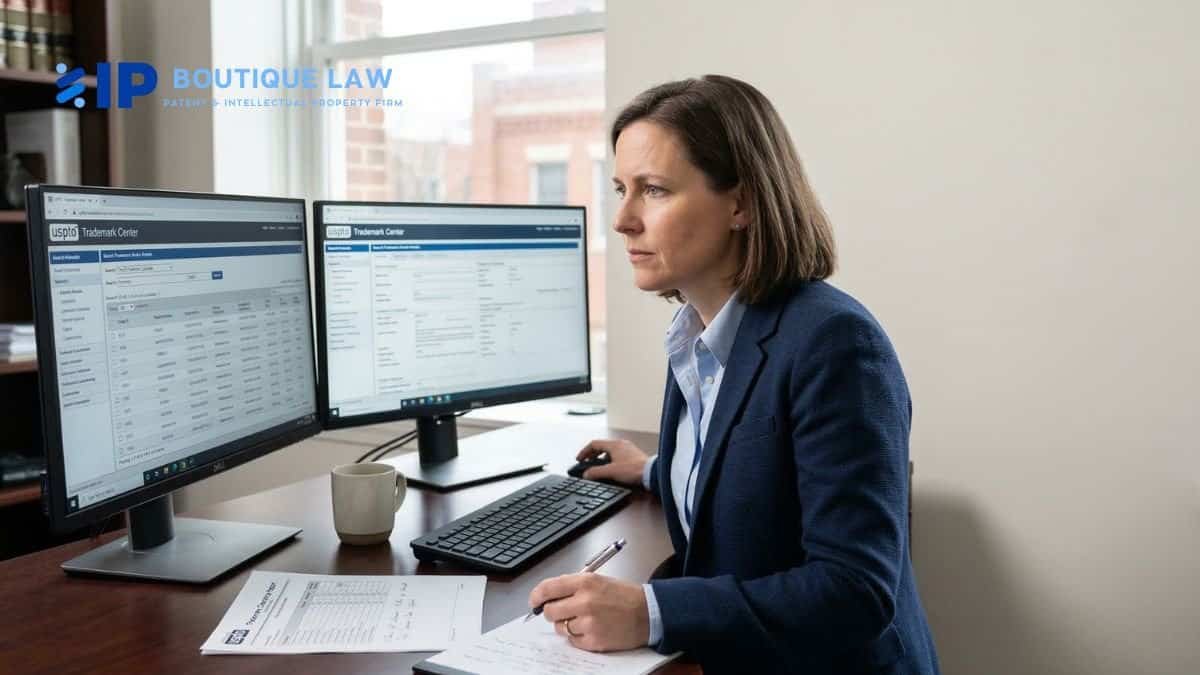
The USPTO examining attorney assigned to your application will conduct their own trademark search — but only after you pay a non-refundable filing fee of $350 per class. By that point, the search is not being done for your benefit. It is being done to find reasons to refuse your application. A clearance search done before filing is a different exercise entirely: it is done to protect your investment, your brand, and your timeline before any money changes hands.
At IP Boutique Law, we approach trademark clearance from the examiner’s side of the desk. We know what triggers a refusal because we have evaluated these conflicts ourselves. The difference between a trademark that registers cleanly and one that spends 18 months in office action responses often comes down to what was — or was not — done before the application was filed.
Last updated: March 2026
What a trademark clearance search actually covers
Most applicants think of a trademark search as a single database lookup. It is not. A proper clearance search covers three distinct layers, and the USPTO examining attorney only covers one of them.
Federal trademarks are registered and pending applications in the USPTO’s Trademark Center database. This is the layer the examiner reviews. It includes marks that are live, dead, pending, and registered — and it is only the starting point.
State trademark registrations exist in each of the 50 states and are not part of the federal database. A business operating regionally may have registered a mark at the state level without pursuing federal registration. Those rights are enforceable within that state and can still create conflicts.
Common law trademark rights are the most frequently overlooked category. In the United States, trademark rights arise from use in commerce — not from registration. A business that has been using a mark for years without ever filing an application still holds enforceable rights in the geographic areas where it operates. These marks do not appear in TESS or Trademark Center. They surface in business directories, domain registrations, social media platforms, and state business filings.
According to the USPTO, a comprehensive clearance search involves searching the federal trademark database, state trademark databases, and the internet. The examining attorney’s search covers only the first category. The other two are the applicant’s responsibility — and they are the categories where applicants most often discover conflicts too late.
The refusals examiners issue most often — and why they are avoidable
The USPTO publishes its grounds for refusal in the Trademark Manual of Examining Procedure (TMEP). Two categories account for the large majority of substantive refusals.
Likelihood of confusion under Section 2(d) is the most common reason a trademark application is refused. The USPTO identifies this as one of the most frequent bases for rejection, and it is the one most directly addressed by a proper clearance search.
The analysis does not require that two marks be identical. Examiners apply a multi-factor test — the DuPont factors — that weighs the similarity of the marks in appearance, sound, meaning, and commercial impression, alongside the relatedness of the goods and services. A refusal can issue even when marks share only one or two words, if those words are the dominant elements and the goods are related. The test is whether an ordinary consumer would be confused about the source of the goods or services. Examiners apply this standard broadly.
Merely descriptive marks under Section 2(e)(1) are the second most common refusal. If a mark immediately describes a quality, ingredient, characteristic, or function of the goods or services, the examining attorney will refuse registration on the principal register. “Cold Brew Coffee” for a coffee product. “Fast Delivery” for a logistics service. These marks cannot be registered as-is because they fail to distinguish one source from others.
This is a refusal a clearance search can anticipate. An attorney reviewing a proposed mark before filing can assess whether it describes rather than distinguishes — and advise on whether a stronger, more registrable alternative exists before the fee is paid and the application is on file.
Why “confusingly similar” goes much further than you expect
Running an exact-match search in the USPTO’s Trademark Center and finding no results does not mean the mark is clear. The likelihood of confusion standard evaluates much more than identical spelling.
Examiners assess marks for phonetic equivalents — marks that sound alike even when spelled differently. “Kleen” and “Clean,” “Xcel” and “Excel,” “Fyre” and “Fire” have all been found confusingly similar to existing marks. The test is how a consumer would say the mark, not how it is written.
Foreign language equivalents are another category that surprises applicants. The doctrine of foreign equivalents holds that a mark in a foreign language may be translated and compared to an English-language mark if consumers who speak that language would recognize the translation. A mark that means “golden” in Spanish may conflict with an existing “Golden” mark in a related goods class.
Commercial impression is the broadest dimension. Two marks can look different on paper but create the same overall mental association for consumers. Examiners evaluate the total effect of the mark — not individual components in isolation. This is why marks that differ in sound, appearance, or meaning can still be found confusingly similar when they produce the same commercial impression.
This is also why searches limited to the federal database and exact matches generate false confidence. A clearance search worth relying on evaluates phonetic variants, design codes for logo marks, foreign equivalents, and related goods categories — not just the proposed mark as written.
What happens when you skip the search
The consequences are concrete and sequential.
Filing fees paid to the USPTO are non-refundable. The base application filing fee is $350 per class of goods or services, as of the January 2025 fee schedule. A multi-class application can run $700, $1,050, or more — paid before any examination begins.
When an examining attorney issues a likelihood of confusion refusal, the applicant receives an Office Action and has three months to respond (extendable to six months for an additional fee). Attorney fees for a substantive Office Action response — one requiring legal arguments, evidence of distinctiveness, or consent negotiations — typically run $1,500 to $3,500 per response. Complex refusals require more. And if the examining attorney issues a final refusal, the next step is an appeal to the Trademark Trial and Appeal Board (TTAB), which adds cost and timeline.
Beyond USPTO fees, the deeper cost is brand investment made before the conflict surfaces. Businesses that skip clearance often discover the problem after product launch, after packaging is printed, after a domain is acquired, and after marketing spend is committed.
At that point, even a relatively weak prior mark creates significant leverage. Forced rebranding after launch — new name, new logo, new domain, new collateral — routinely costs far more than the legal fees that would have caught the conflict at the outset.
The clearance search is the cheapest point in the trademark process to find a problem. The filing is the second cheapest. Everything after that is more expensive. For a detailed look at how these costs compound, our article on trademark application costs in 2026 breaks down the full fee structure.
When to conduct the search
The right time to run a clearance search is before any public commitment to the mark — not before filing, but before adopting the mark at all.
Ideally, clearance happens before product launch, before domain acquisition, before investor presentations, and before packaging or labeling is finalized. Each of those steps represents investment in the mark. Investment in the mark before clearance is investment at risk.
A clearance search is not a guarantee. New applications are filed with the USPTO every day, and trademark rights can arise from use without any filing at all. The purpose of the search is not to eliminate uncertainty entirely — it is to identify known risks, assess their significance, and make an informed decision about whether to proceed. That is a different standard than hoping the examining attorney finds nothing.
For businesses preparing to file, our complete guide on how to file a trademark application with the USPTO in 2026 covers the full process from clearance through registration.
Frequently asked questions
The USPTO does not require it, but the agency strongly recommends a clearance search before filing any application. Likelihood of confusion is the most common reason applications are refused, and it is a refusal that a proper search can identify before money is spent. Skipping the search transfers risk onto the application.
A professional clearance search covering federal, state, and common law sources typically runs $500 to $1,500 depending on scope and complexity. That cost needs to be weighed against USPTO filing fees of $350 per class — paid regardless of outcome — plus potential Office Action response fees of $1,500 to $3,500 if a conflict surfaces during examination.
If the examining attorney finds a confusingly similar registered mark in a related goods or services class, they will issue a Section 2(d) refusal. The applicant can argue against it, seek a consent agreement from the prior registrant, or amend the identification of goods to avoid overlap. None of those options are guaranteed to succeed, and all take time and legal fees. The prior registrant can also oppose the application during the publication period, or seek cancellation of a registration after it issues.
You can search the USPTO’s Trademark Center database yourself, and doing so is better than nothing. The limitation is that Trademark Center searches require understanding how examiners evaluate similarity — phonetic equivalents, design codes, related goods classifications — and what constitutes a meaningful conflict versus a coincidental match. A self-search that misreads the results provides false confidence. The more consequential gap is that Trademark Center does not cover state registrations or common law use.
A professional clearance search typically takes two to five business days for a comprehensive report covering federal, state, and common law sources. An IP Boutique Law attorney review and opinion on the results adds time but produces a defensible assessment of registrability — not just a list of marks found.
A trademark clearance search is not a formality before filing. It is the point in the process where the risk profile of a brand becomes visible — before the investment in that brand becomes difficult to reverse. We work with clients to evaluate that risk honestly, using the same analytical framework examiners apply, applied earlier and in their favor.
IP Boutique Law is a patent and intellectual property firm in Washington, D.C. with 25+ years of USPTO examiner experience. Our team handles patent drafting, prosecution, trademark registration, design patents, provisional applications, ex parte reexamination, and patent reissue across chemical, biochemical, electrical, and mechanical fields. We serve inventors and companies in the U.S. and internationally, bringing insider examiner knowledge to every stage of the patent process.
Schedule a trademark consultation to discuss your mark before filing. Reach us at +1 202 773 9579 or contact@ipboutiquelaw.com.
Reviewed by Carlos López, patent attorney and former USPTO examiner with 25+ years of IP experience.