

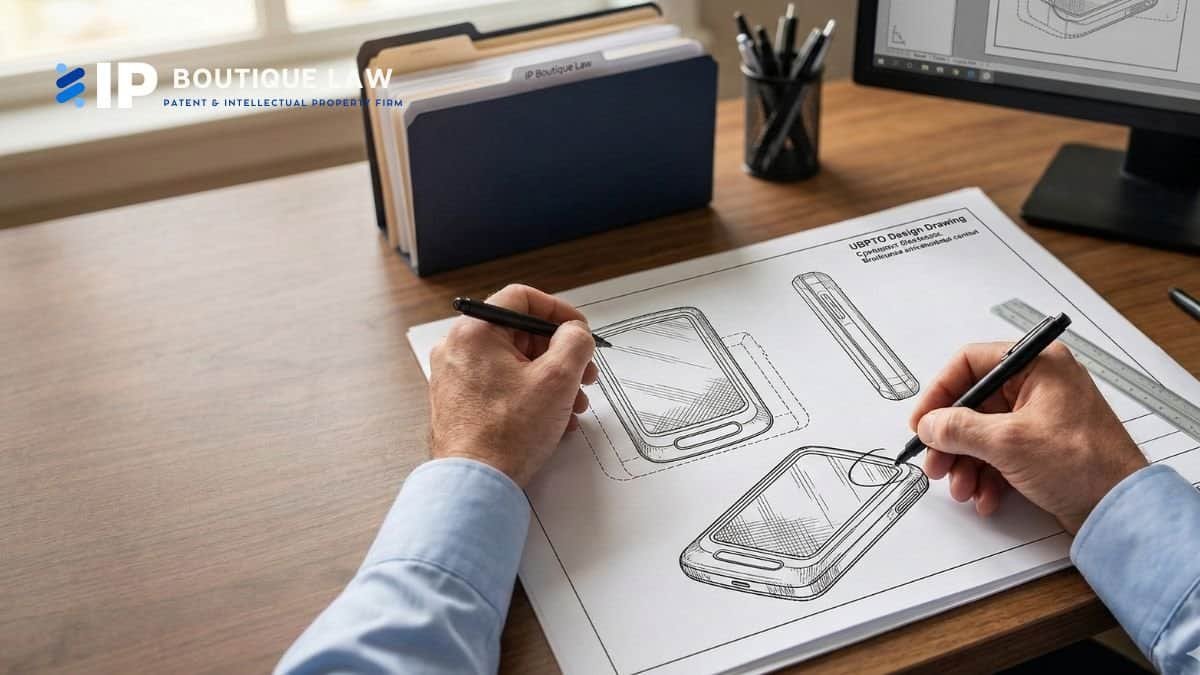
A design patent protects the ornamental appearance of an article of manufacture — not how it works, but how it looks. Under 35 U.S.C. § 171, the USPTO grants design patents for designs that are new, original, and ornamental. But what that means in practice is more nuanced than the statute suggests. Examiners evaluate not just whether a design looks unique, but whether the appearance is genuinely ornamental rather than the inevitable result of functional choices. That distinction determines whether your application succeeds or fails before examination even begins.
Last updated: March 2026
The ornamental vs. functional line — where most design patent questions start
The single most important concept in design patent eligibility is the ornamental/functional distinction. The USPTO, under MPEP Section 1502, defines design as “the visual ornamental characteristics embodied in, or applied to, an article of manufacture.” According to the USPTO’s MPEP Section 1502, a design patent may cover configuration (shape), surface ornamentation applied to an article, or the combination of both — but only to the extent those features exist for appearance, not function.
This is where most inventors get confused. They assume that if a product has functional features, design patent protection is unavailable. That assumption is wrong.
When a functional article can still get design protection
A product does not need to be purely decorative to qualify. Design patents routinely issue for highly functional articles — shoes, smartphones, beverage containers, medical devices — because the protection attaches to the ornamental expression of those articles, not their underlying utility.
The controlling question examiners ask: was this design chosen for how it looks, or because it was the only shape that could perform the function? If a design could have taken dozens of different forms and the creator chose this one for aesthetic reasons, the ornamental standard is satisfied. If the design is dictated entirely by engineering constraints — the only shape that works — it is not protectable by a design patent regardless of how it looks to an ordinary observer.
An automobile hood is a useful example. Hoods serve a clear functional purpose. But examiners routinely approve design patents covering the sculpted lines, contours, and surface geometry of specific hood designs, because those specific aesthetic choices are not required by function. A different hood shape would work equally well. That design freedom is what makes protection available.
When the USPTO denies design protection despite ornamental appearance
Examiners apply a stricter standard than “does this look nice.” A design that happens to be visually appealing but was selected entirely because it performed better — reduced wind resistance, enabled easier manufacturing, improved grip — does not qualify. The appearance must be separable from the functional rationale.
We have examined applications where the only configuration that worked was also visually distinctive. Those applications were properly refused design patent protection, because the design was dictated by utility, not by ornamental intent. The lesson for applicants: document why specific aesthetic choices were made independently of engineering requirements. That record supports ornamentality when an examiner questions it.
Categories of articles that qualify for design patent protection
The USPTO design patent application guide specifies three subject matter categories: configuration or shape of an article, surface ornamentation applied to an article, and the combination of both. Within those categories, qualifying articles span a wide range of industries.
Physical product configurations and shapes
The shape or three-dimensional configuration of a manufactured article is the most common subject matter for design patents. Examples that regularly issue include:
- Beverage container shapes (the Coca-Cola contour bottle held a now-expired design patent)
- Furniture silhouettes and profiles
- Shoe soles and upper configurations
- Electronic device housings and form factors
- Eyewear frames
- Automotive body panels and trim elements
- Medical device and instrument configurations
- Packaging and container forms
The article must be a tangible, man-made object. Per the Federal Circuit’s 2021 ruling in In re SurgiSil, a design claim is strictly limited to the article of manufacture identified in the claim — design protection does not extend broadly to a design in the abstract. This case is significant because it closed a potential loophole: you cannot file a design patent for a lip implant shape and then enforce it against a different article that happens to share that shape.
Surface ornamentation applied to an article
Surface patterns, textures, and decorative treatments applied to a product also qualify, separately from the shape of the product itself. A textile pattern applied to fabric, a graphic treatment on a phone case, a repeating decorative motif on wallpaper — these are protectable as design patents when applied to and inseparable from a specific article of manufacture.
One important nuance: the design must be capable of reproduction. In an older case, a company sought design patent protection for a unique cloudy appearance achieved by a decorative coating method on wallpaper. The USPTO refused, because the appearance varied with each application of the method — it was not a definite, preconceived, reproducible design. Methods cannot be protected through design patents, even when they consistently produce visually appealing results.
Graphical user interfaces and computer icons
GUI design patents are a significant and often overlooked category. Computer icons, graphical interfaces, and screen layouts qualify for design patent protection when they are claimed as part of an article of manufacture — specifically, displayed on a computer screen, monitor, or display panel. An icon as a standalone image does not qualify, but the same icon displayed on a screen meets the article of manufacture requirement.
Apple’s extensive design patent portfolio covering iOS interface elements — icons, screen layouts, transition animations — demonstrates the commercial value of this category. Font designs also qualify under this framework when tied to a specific article. This is a growing area of protection for software companies, app developers, and any product with a distinctive user interface.
Partial designs and component-level claims
Following the Supreme Court’s 2016 decision in Samsung Electronics Co. v. Apple Inc., design patent claims can protect a component of a multi-component product, not just the entire product. This matters for strategic filing. A company can file separate design patents covering specific components — a hinge design, a display bezel, a button configuration — rather than being limited to one patent covering the whole device.
Broken lines in design patent drawings are how this is accomplished. Elements shown in broken lines are disclaimed — they are not part of the claimed design. Only solid-line elements are protected. This gives applicants significant control over the scope of protection. A design patent attorney structures the drawing set to cover the novel ornamental elements strategically, using broken lines to exclude features that are functional or that would unnecessarily narrow the claim.
What the USPTO specifically excludes from design patent protection
Understanding what does not qualify is as important as knowing what does. Examiners actively look for these grounds to reject applications.
Designs dictated solely by function
A configuration driven entirely by functional necessity is not protectable as an ornamental design. The CCPA stated in In re Rubinfield that the controlling matter is “the appearance of a design as a whole.” When that overall appearance is the inevitable result of functional choices — not aesthetic ones — no design patent will issue.
A hex nut is a useful reference point. Its shape is visually distinctive, but examiners have long recognized that the hexagonal configuration exists because it works, not because someone chose it for aesthetic reasons. No design patent issues for the shape of a standard hex nut. The same logic applies to any configuration where function leaves no room for aesthetic choice.
Designs not visible during normal use
Design patent protection is unavailable for ornamental features that are not visible when the article is in its normal intended use. Internal components, underside surfaces that face away from view during use, or features concealed by assembly all fall outside protectable subject matter. If an ordinary observer would never see the design while the product is being used, that design is not a protectable ornamental feature.
Non-repeatable designs
A design must be a definite, preconceived, reproducible creation. Designs that are the chance result of a manufacturing method — where each instance differs — do not qualify. This requirement reflects a basic principle: you cannot hold a monopoly over a result you cannot define and reproduce with consistency.
Abstract designs not tied to an article of manufacture
Under Curver Luxembourg, SARL v. Home Expressions, Inc. (Fed. Cir. 2019), design patents are granted only for designs applied to specific articles of manufacture — not for designs in the abstract. A surface pattern claimed without a specific article is not protectable. Per the Cornell Legal Information Institute’s analysis of design patent law, the design and the article are legally inseparable — a principle consistently applied across decades of Federal Circuit precedent.
How solid and broken lines define what you actually own
The drawings in a design patent application are the claim. There is one claim, and it refers entirely to the drawings. This makes the drawing strategy — specifically the choice of what to show in solid versus broken lines — the most consequential decision in design patent prosecution.
Solid lines define the claimed ornamental design. Broken lines show context — the environment or product features that surround the design — but those elements are expressly excluded from protection. Apple’s design patent strategy in Apple v. Samsung illustrated this precisely. Apple showed much of the iPhone design in broken lines, meaning Samsung’s differences in those areas were irrelevant to infringement. The solid-line elements — the specific screen proportions, the rounded corner geometry — were what mattered, and Samsung’s phones replicated them.
From an examiner’s perspective, we review broken-line usage carefully. The USPTO design patent application guide requires a statement in the specification explaining what the broken lines represent. Examiners reject applications where the broken-line usage is inconsistent with the described claim or where required views are missing. Getting the drawing strategy right from the start is what separates a design patent with broad, enforceable protection from one that is easily designed around.
If you’re evaluating whether your product qualifies and what scope you can realistically claim, our design patent application guide covers the specific drawing requirements examiners apply. A patent search before filing also confirms your design is novel — the USPTO will conduct its own search, but knowing the prior art landscape in advance shapes a stronger application.
Design patent protection in practice — what it covers and what it doesn’t
A granted design patent gives the owner the right to prevent others from making, using, selling, or importing a product whose design is substantially similar to the claimed design. The infringement standard — established in Gorham Co. v. White (1871) and refined by the Federal Circuit in Egyptian Goddess, Inc. v. Swisa (2008) — asks whether an ordinary observer, familiar with the prior art, would find the accused design substantially the same as the patented design.
Design patents filed on or after May 13, 2015 carry a 15-year term from the date of grant. According to the current USPTO fee schedule, no maintenance fees are required to keep a design patent in force — unlike utility patents, which require payments at 3.5, 7.5, and 11.5 years after grant.
One underused strategy is dual protection: a product can simultaneously hold a utility patent covering its functional features and a design patent covering its ornamental appearance. Trade dress registration through the USPTO is a third layer that can complement both. These protections cover different legal theories and provide overlapping coverage that significantly raises the cost of copying for a competitor.
For a direct comparison of what design versus utility patents protect and when each makes strategic sense, our article on design patent vs. utility patent key differences covers that question in detail.
FAQs
A design patent qualifies for any new, original, and ornamental design for an article of manufacture under 35 U.S.C. § 171. The design must be tied to a specific physical or digital article, must be reproducible, and must be chosen for aesthetic reasons rather than dictated entirely by functional necessity. Configuration, surface ornamentation, or both can qualify.
Yes. A design patent can protect the ornamental appearance of a functional product as long as the specific design choices were made for aesthetic reasons, not forced by engineering requirements. Shoes, smartphones, and medical devices all regularly receive design patents. Protection attaches to how the product looks, not how it works.
A design patent protects how an article looks; a utility patent protects how it works. Design patents have a 15-year term from grant with no maintenance fees. Utility patents have a 20-year term from filing with maintenance fees due at 3.5, 7.5, and 11.5 years. Both can be obtained simultaneously for the same product when it has novel appearance and novel function.
A design patent filed on or after May 13, 2015 lasts 15 years from the date of grant. No maintenance fees are required to keep it in force — unlike utility patents. Design patents filed before May 13, 2015 carry a 14-year term.
Design patents cannot protect designs dictated solely by function, designs not visible during the article’s normal use, designs that are not reproducible (chance results of a method), or designs not tied to a specific article of manufacture. Abstract patterns claimed without a specific article are also excluded, per the Federal Circuit’s 2019 ruling in Curver Luxembourg v. Home Expressions.
Yes, graphical user interfaces, computer icons, and screen layouts can receive design patent protection when claimed as part of an article of manufacture — specifically, as displayed on a screen or monitor. An icon standing alone does not qualify, but the same icon displayed on a device display meets the article of manufacture requirement under USPTO guidelines.
Working with a design patent attorney to evaluate what qualifies
Determining whether a specific design qualifies — and how broadly it can be claimed — requires evaluating the ornamental/functional balance, the prior art, and the drawing strategy together. Generic analysis produces narrow or vulnerable patents.
Having examined design applications at the USPTO, we know the specific arguments examiners use to deny protection for designs that are predominantly functional. We also know how to structure claims and drawings to maximize protectable scope while maintaining a defensible ornamental foundation.
IP Boutique Law is a patent and intellectual property firm in Washington, D.C. with 25+ years of USPTO examiner experience. Our team handles patent drafting, prosecution, trademark registration, design patents, provisional applications, ex parte reexamination, and patent reissue across chemical, biochemical, electrical, and mechanical fields. We serve inventors and companies in the U.S. and internationally, bringing insider examiner knowledge to every stage of the patent process.
If you have a product with distinctive visual features and want to evaluate your options, contact our team to discuss whether design patent protection fits your situation. We can also be reached at +1 202 773 9579 or contact@ipboutiquelaw.com.
Reviewed by Carlos López, patent attorney and former USPTO examiner with 25+ years of IP experience.